Skip to content

May 2026

We Forgot How to Leave

Blog HeaderWe’ve got a choice but still we’d rather choose to suffer ”— Architects, Impermanence

I was outside with my dog this morning when I noticed a nest of caterpillars in one of my apple trees. I have an orchard — and before you picture rows of perfect trees stretching to the horizon, let me be clear. I bought an old orchard property a few years ago (it was built in the 1850’s). I’ve got six trees. I’m learning as I go. It’s a hobby. It’s a long game. I have come to appreciate the long game. Trees take years to acclimate before they produce anything, and most of what I’m doing right now is just tending and watching and figuring out what I don’t know yet.

But the caterpillars. They’re invasive — probably gypsy moth, I need to ask my cousin, he’s the bug expert. A few years ago in New York, they came through and killed a lot of good trees. And I stood there this morning with this tiny ethical moment: I don’t like killing things. I prefer to let nature take its course, but with invasive species, that is not always a good thing. For my orchard, and the local habitat, it is not. I believe in balance. The tree is better for the ecosystem than the caterpillars are. It’s not about the tree versus the caterpillars. It’s about the system. Future trees. The soil. The birds that nest in those branches. The whole web of relationships that one tree supports. Not to mention the trees the caterpillars that are growing now will eat. The cycle will continue. Sometimes protecting the system means making a hard call. The challenge now, is how to do so surgically, with the least damage. I like challenges. I will let you know how that turns out when I figure it out.

The Architecture of Intellectual Retreat Part Three

Blog Header I sat with this one for several days before writing. I needed to ensure I was seeing clearly before acting. As this is not really a light subject, and is different as it deals with something many are uncomfortable with.
Accountability.

The first two pieces in this series came out quickly. Ellen blocked me and I wrote. Maggie blocked me and I wrote. The pattern was the pattern and the work was to describe it.

How Einstein Held Himself Back

Blog Header "“Trying is the first step towards failure” — Homer J Simpson"

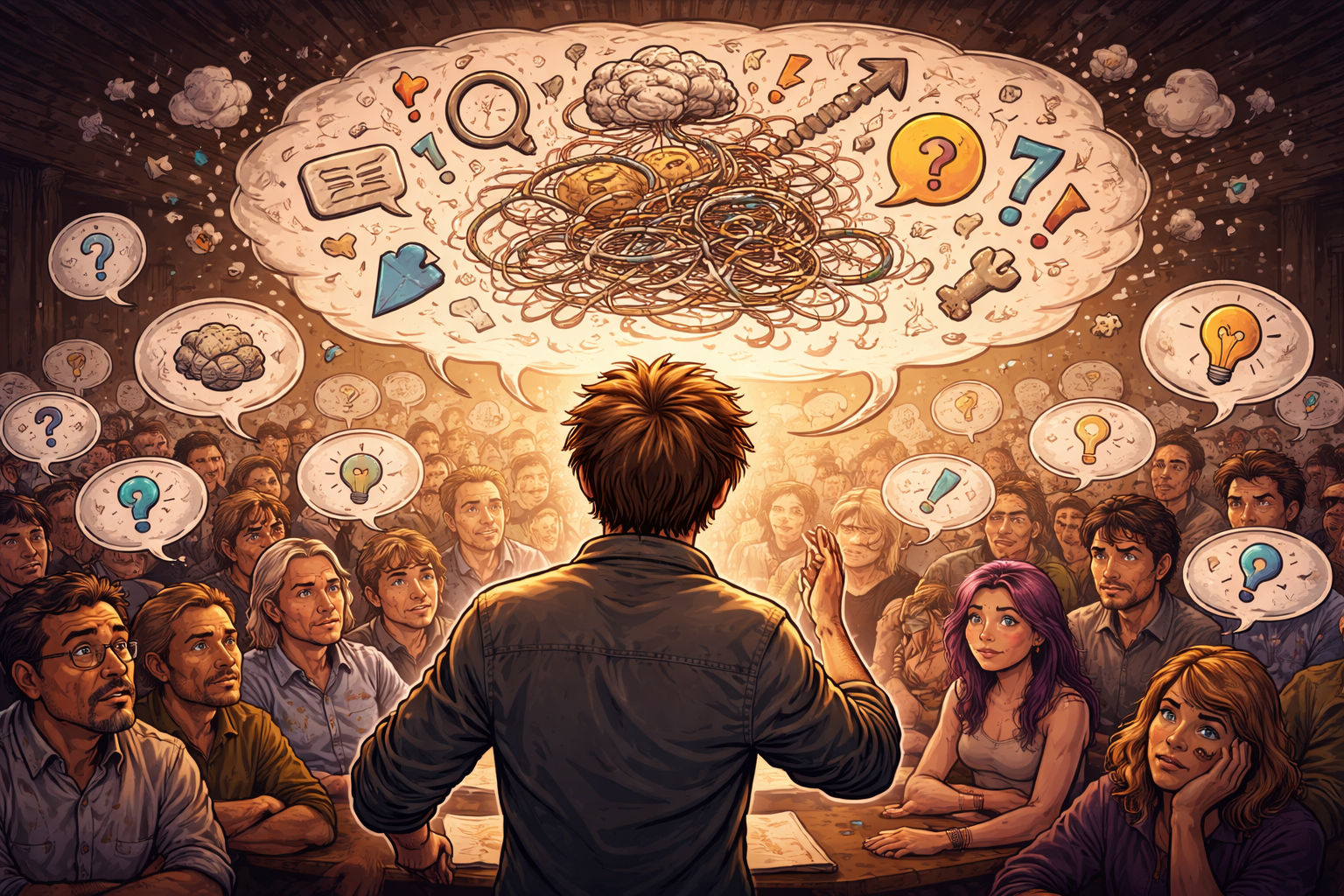
Nearly everyday, someone tells me what I meant. Not what they thought I meant — what I meant. I said, “No, that’s not what I’m saying.” They argue with me about it. They told me I was wrong about what I meant. “I don’t mean any disrespect but, you couldn’t have meant that. You must have meant [insert their interpretation of what they think is going on inside my head - see figures 1 and 2] because of [insert some word or phrase] you said. That always means [insert incorrect interpretation of what I meant]”.

Think about that for a second. Someone who is not me, who does not live inside my head, who does not share my experiences or my definitions, told me that my meaning, what my intent was — the thing I am the only authority on — was incorrect. And then demanded I defend their interpretation of my words instead of my own. If I do, I have assumed their premise and already lost. What a tricky trick!

This happens to me constantly. I stopped trying to count when it happens, it’s just demoralizing once you see it. Best not to focus on it. Here is the thing, it probably happens to you too. And I think it’s one of the biggest problems we don’t talk about, because it sits underneath almost every argument, every misunderstanding, every collapsed conversation, and every stalled theory in the history of human thought.

Gonzo Intellectualism A Clip Show

Blog Header "“In America, you can always find a party. In Soviet Russia, Party always finds you.” —Yakov Smirnoff (probably)"

The name of what I have been doing has come to me. And it is one of my favorite influences from college (the first time around). This might be, perhaps, a more advanced form (and hence more dangerous- nothing comes without cost) of interconceptualism.

Not because it needs a label to work. It’s been working fine without one. But because new people keep showing up — hi, welcome, don’t mind the mess, sorry about that, by the way, watch out, there’s no floor — and I realized there’s no clean entry point. I’ve been writing for a little while now. The ideas build on each other. I haven’t really planned it that way. I have let it grow organically. If you showed up yesterday, you’re walking into season four of something that never had a pilot episode (or a consistent first season). You’re that person at the party who arrived late and everyone’s laughing at an inside joke and you’re standing there with your drink like “what did I miss?”

This is the clip show. For the uninitiated.

An Experiment on Events and Relations

Blog Header "“We understand the world in its becoming, not in its being.” — Carlo Rovelli, The Order Of Time"

A note on what you’re about to read.

I’ve been experimenting with how I write these essays. As a composer — that’s what I am first, a musician, a creative — I’ve always known there are many ways to build something. Sometimes you sit down and write it out on sheet music first. Sometimes you just play. Sometimes you jam. Other creatives know this. Other writers know this. The creative process itself is part of the work, and experimenting with it is how you find what’s true.

This piece is an experiment (as everything on this blog is- please treat all of it as such). It is partially me talking things out in conversation — because that’s how I actually think. I need interaction to grow and learn, it creates valuable information that you simply cannot get from inanimate things. I need friction, dialogue, pushback. Otherwise I spin circles. If I could just sit in a room and figure it all out alone, I would. I can’t (I actually don’t think anyone can, and that there might be evidence to support that). I need another mind, whether that’s a person, an AI, a whiteboard, or myself talking out loud. That’s how the thinking moves forward. The other part is my more traditional process — outlining, structuring, shaping. I merged them. So what you’re reading will shift between me clearly just thinking out loud and more polished writing. That’s intentional. That’s the point.

The Architecture of Intellectual Retreat Part Two

Blog Header "We do not see things as they are. We see things as we are." — Anaïs Nin

I posted a note right after this happened. It said:

I’ve been sitting with that since I wrote it. And I still don’t get it. But I think it’s worth expanding on, because what happened with Maggie is not an isolated incident. It’s a pattern, the same one I have been talking about. And the pattern is telling us something about the state of discourse — not just on Substack, but everywhere.

Full transparency: my original note didn’t say “what is wrong with the discourse.” It said “what is wrong with people.” I changed it because that framing was not appropriate — and I know better. Intellectually, I do not believe there is anything wrong with people. What looks like a flaw is incomplete information. But the learned patterns in my neocortex keep defaulting to that heuristic. The frustrated, reactive shortcut that says something is wrong with them instead of something is missing from the picture .

The Architecture of Scientific Stagnation

Blog HeaderAnalysis of error begins with analysis of language.” — Hans Reichenbach, The Rise of Scientific Philosophy

A note before I get into this. I am an empath and a highly sensitive person. For most of my life — decades — I confused other people’s emotions for my own. I couldn’t tell the difference. When you can’t trust your gut, when you don’t know if the fear you feel is even yours, you either collapse under it or you figure out what emotions actually are at a level most people never have to. I did the latter. Not because I’m smart. Because I had no other option.

So when I tell you that most people — including most scientists — do not understand what emotions are, I’m not being provocative. I’m telling you what I found when I had to take the whole thing apart to survive it. What follows is not an attack on feeling. I would never. It’s an argument that the confusion between what emotions are and what we think they are is quietly paralyzing our ability to make progress. On anything.

And yes — this entire post is about how emotional reactions masquerade as rational positions. Which means it applies to me too. That’s literally the point. If it didn’t apply to me, it wouldn’t be universal, and if it’s not universal, it’s not real. This way we’re all on equal footing. I’ve tried to build this honestly. That’s the best I can do. That’s the best any of us can do.

It's Done When It's Done

Blog HeaderWe live in a society exquisitely dependent on science and technology, in which hardly anyone knows anything about science and technology.” — Carl Sagan

It’s been nearly two months.

I’m not going to apologize for that. What I am going to do is tell you what I’ve actually been wrestling with, because I think you deserve that much.

First, the obvious: life happened. Family comes first. That’s not an excuse — that’s just the order of things, and I wouldn’t change it. Anyone who has been reading long enough knows that I’m not doing this for the numbers. I’m not optimizing for engagement. I’m not building a content calendar. So when life pulls, I go. Every time.

Res2vec Extracted Word Embeddings

Blog HeaderYou shall know a word by the company it keeps.” — John Rupert Firth

Word embeddings have always required training. This is such a fundamental assumption in the field that it barely registers as an assumption at all. Word2Vec, GloVe, fastText—all demand iterative optimization. Epochs. Hyperparameter tuning. Gradient descent grinding away at your corpus, pass after pass, slowly converging toward something useful. You feed in a billion tokens, you wait, you hope the learning rate was right, you check the loss curves, you benchmark, you adjust, you run it again.

This is how it’s done. There aren’t alternatives. Until now.

Res2Vec doesn’t train. It computes. (See the results here, paper to come: res2vec-owt1b-188d )

Reference Frames as Vectors A Resonance Perspective on Special Relativity

Blog HeaderEverybody at the party is a many sided polygon....Nonagon!” — They Might Be Giants

There are moments when in deep study of a familiar subject when concepts suddenly reveal themselves as masks for something deeper. When things snap into place and what you thought you knew turns on its head. Our existing knowledge seems to re-contextualize around us. What we knew is still true, but yet, somehow different. This is how we build deeper understanding.

Before I share more of Resonance Theory, I want to share some of the things that I noticed before it came to be. The initial patterns I noticed that, when we see them, we may feel they were obvious, and they were. We have seen them before. We just never really connected the dots quite like this to start seeing the bigger picture.