Gonzo Intellectualism A Clip Show
 "“In America, you can always find a party. In Soviet Russia, Party always finds you.”—Yakov Smirnoff (probably)"
The name of what I have been doing has come to me. And it is one of my favorite influences from college (the first time around). This might be, perhaps, a more advanced form (and hence more dangerous- nothing comes without cost) of interconceptualism.
Not because it needs a label to work. It’s been working fine without one. But because new people keep showing up — hi, welcome, don’t mind the mess, sorry about that, by the way, watch out, there’s no floor — and I realized there’s no clean entry point. I’ve been writing for a little while now. The ideas build on each other. I haven’t really planned it that way. I have let it grow organically. If you showed up yesterday, you’re walking into season four of something that never had a pilot episode (or a consistent first season). You’re that person at the party who arrived late and everyone’s laughing at an inside joke and you’re standing there with your drink like “what did I miss?”
This is the clip show. For the uninitiated.
If you’ve watched The Simpsons (or tv really) — and if you haven’t, I’m not sure how you’ve been spending your time — you know what a clip show is. It’s the episode where the family sits on the couch and reminisces about previous episodes. Clips play. You get the highlights. The writing staff gets a week off. Everyone wins.
I’m doing that. Except the couch is Substack, the family is whoever is reading this, and the writing staff — me — is definitely not getting a week off because I’m simultaneously going to define a thing while doing the thing while showing you the thing. That’s three layers. That might be too many layers. We’re doing it anyway.

S09E11 - 01/04/1998
Share
We Live in The Simpsons Now
Before I get into the intellectual stuff, I need to say something that has been forming for a while. The Simpsons is awesome. Depending on who you talk to, you can find out when they came of age, because those are their favorite years and thus they inevitably comment that that was when it was the best (it’s a rule of thumb really, maybe, has looked into that? Should I do that?).
The Simpsons used to seem to be prophetic. This was a whole thing. They “predicted” smartwatches. They “predicted” the Disney-Fox merger. They “predicted” a Trump presidency. People made compilation videos. It became a meme. Ha ha, Simpsons did it first.
I don’t think The Simpsons is prophetic anymore. I think it flipped.
Think about it. The show was built on absurdist satire — taking the stupidity of American life and exaggerating it until it became comedy. Homer sticks a crayon up his nose and becomes dumber (great episode, classic). Mr. Burns blocks out the sun (also classic). The town collectively panics over nothing, repeatedly, learning nothing each time.
That used to be satire. Exaggeration. Comedy through distortion.
Now? Now I watch the news and think “this is a Simpsons episode, this can’t be real.” Not metaphorically. Structurally. The patterns are the same. The logic is the same. People are actually doing the things that were written as jokes. We haven’t caught up to The Simpsons’ predictions — we’ve lapped them. We are ahead of the satire. Reality became more absurd than the show designed to satirize it.
I actually feel like I have seen comedians complain about this phenomena.
The Simpsons isn’t predicting the future anymore. We’re living in The Simpsons. The show is now a documentary that was accidentally filmed as a cartoon thirty years early.
And honestly? That’s the most Simpsons thing that could have happened. The show about a society too absurd to be real became less absurd than the society watching it. Homer would be confused by our timeline. Homer. The man who thought bacon, ham and pork could not possibly come from the same animal and Lisa, who claimed it, must be referring to a magical creature that could not possibly exist. Of course we all know that creature is commonly known as a pig (classic).
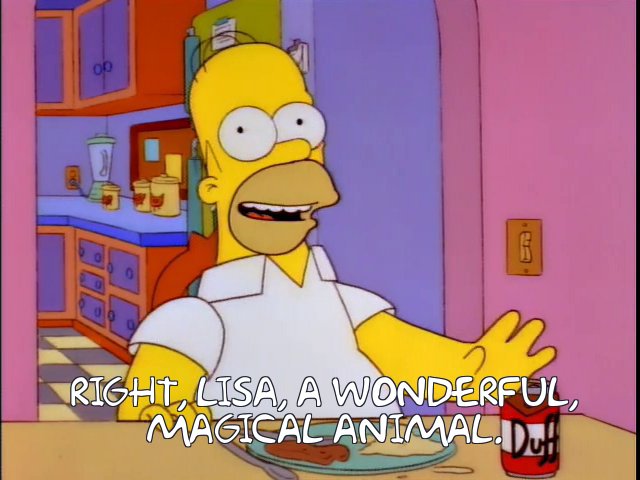
S07E05 - 10/15/1995
I bring this up because it’s relevant to what I’ve been doing and why. When reality becomes indistinguishable from satire, the only honest intellectual response is to stop pretending seriousness is the same as rigor. They’re not. They never were. Seriousness is a performance. Rigor is a practice. You can have one without the other. Most of academia has figured out the seriousness part and completely lost the rigor. I’m trying to do the opposite. I am actually always serious, I just don’t seem like it.
Which brings me to the thing I need to name.
What Is Gonzo Intellectualism?
You know Gonzo Journalism? Hunter S. Thompson. Fear and Loathing in Las Vegas. The whole bit. Thompson’s move was simple and devastating: he refused to pretend he wasn’t part of the story. Traditional journalism said: the reporter is invisible. The reporter is objective. The reporter observes and documents without influencing. Thompson said: that’s a lie. The reporter is always in the story. Always influencing it. Always subjective. The only honest thing to do is admit it and make the subjectivity visible. Put it on the page. Let the reader see the mess.
The observer is always an influence on what it is observing, directly or indirectly.
Thompson didn’t break journalism. He broke the lie that journalism was telling about itself. Gonzo Intellectualism is the same move applied to thinking.
Traditional intellectualism says: here is my conclusion. Here are my citations. Here is my careful, detached analysis. The thinker is invisible. The process is hidden. You see the building, never the construction site. The output is polished, the mess is private, and if the thinker changed their mind six times before arriving at the final draft — you’ll never know. That’s by design. The performance of certainty is the product.
Gonzo Intellectualism says: that’s a lie. The thinker is always in the thinking. Always biased. Always uncertain. Always mid-process. The only honest thing to do is make it visible. Show the construction site. Let the reader watch the building go up. Leave the scaffolding. Leave the part where you used the wrong beam and had to swap it out. Because that mistake is data. Hiding it is a lie about how knowledge actually works.
Thompson put the drugs and the paranoia and the rental car on the page because removing them would misrepresent what actually happened. I put the metacognition, the corrections, the CPTSD, and the tangents on the page because removing them would misrepresent how the thinking actually works.
Same move. Different domain. Same honesty.
Here’s the structural comparison, because I like structure:
Gonzo Journalism : The reporter is in the story → subjectivity is the point → the raw experience IS the reporting → mess is the medium → truth through transparency about the observer.
Gonzo Intellectualism : The thinker is in the thinking → subjectivity is the point → the raw process IS the output → mess is the medium → truth through transparency about the mind doing the work.
The traditional journalist pretends they’re a camera. Thompson said: I’m a person, holding a camera, on drugs, in a convertible going 120 in bat country, and if I don’t tell you that, you don’t actually know what you’re looking at.
What happens in bat country, stays in bat country.
The traditional intellectual pretends they’re a logic machine. I’m saying: I’m a person, holding a framework, running on coffee and coffee and years of CPTSD recovery (I consider myself in remission right now), with dogs and a son that interrupt me every few minutes, and if I don’t tell you that, you don’t actually understand the thinking. Because the conditions shape the output. Always. Pretending otherwise is the first lie, and every lie after that builds on it. I did this to survive the chaos. It seems to work for me. It’s also a lot of extra energy to maintain a lie. You don’t have to do anything to remember the truth (or what you believe is the truth).
On With The Show!
If you’re new here, let me show you what this has actually produced. This is the clip show part. The couch. The montage. But we need a narrative framing device? How about the fact that we are doing a clip show? See, I can be lazy like the people in the real world Simpsons.
Anyway, I think I was talking about the measurement problem last we left off…
They’re capable of holding multiple perspectives and viewpoints simultaneously, only collapsing into a single response when they produce an output.¹ The measurement problem, stripped of all the formalism, is essentially asking: how come when we touch something, it reacts to our touch? Sit with that. What are we expecting to happen? An observer directly interacts with a quantum system. The system’s future is altered by that interaction. And this is supposed to be mind-boggling. We don’t understand why this is happening. Except — yes we do. If you touch something, you’re going to alter its course. That’s not a quantum mystery. That’s what interaction is.² We seem to think we can determine another person’s intent just by observing their behavior. Let that sit. Has that ever — in all of human history — actually worked? Her brain constructed a narrative — he’s acting in bad faith — and presented that narrative back to her as fact. And because she treated the inference as fact, everything that followed was perfectly logical. She observed bad faith. She defended herself. She blocked me. Rational response to a real threat. Except the threat wasn’t real. It was inferred. And the inference was wrong.³ Expand the system boundary to include the observer. The measurement problem dissolves when you stop treating the observer as special.²
Ah, the Move! It’s too soon! It’s a clip show, it’s supposed to be easy! Let’s try another channel:
LLMs do not store tables of statistical occurrences and look them up. Each token is stored as a position in a high-dimensional vector space. The relationships between tokens are geometric. The operations are linear algebra — the same mathematics that underlies quantum mechanics and relativity.⁴ Three domains. Three different starting points. The same geometric operation at the heart of each.⁵ A brain’s biological structure is essentially a graph network — nodes, edges, geometry. A social network is essentially a graph network — same math, different variables. Complex adaptive systems are essentially a graph network — same math, different variables. Fundamental physics is essentially a graph network — same math, different variables. Large language models and AI are essentially a graph network — same math, different variables. I mean, all of these are substrate independent, aren’t they? We only say one is conscious though. Why is that?⁶ Anthropocentric bias. Basically, it’s our tendency to think humans are somehow the main characters of the universe’s story.⁷
Well that’s weird. It’s on this channel too. There is something wrong with the remote, hold on. There has to be a channel about something else right?
We understand the world in its becoming, not in its being.³ Output is a past event. The moment you create something, it’s fixed. Done. It cannot grow or change. It’s a snapshot of how you understood something at one particular moment.⁸ You’re saying the universe doesn’t store its outputs. It derives them.⁹ For five hundred years, many creatives have to choose between integrity and survival. AI just destroyed the market for polish. The finished output is now worthless because it’s infinitely reproducible at near-zero cost. The society that was built against artists is finally collapsing. And AI is the hammer that broke it.³ People want the output. They want the result. They want the thing that makes their number go up or their problem go away. Understanding? That’s the part they skip. And if that’s true — if understanding is the part people skip — then releasing something powerful into that environment isn’t enlightenment. It’s just a faster way to stupid.¹⁰ I don’t write these posts. I build them.³
...huh. Perhaps this isn’t the Simpsons. Is it Rick and Morty?
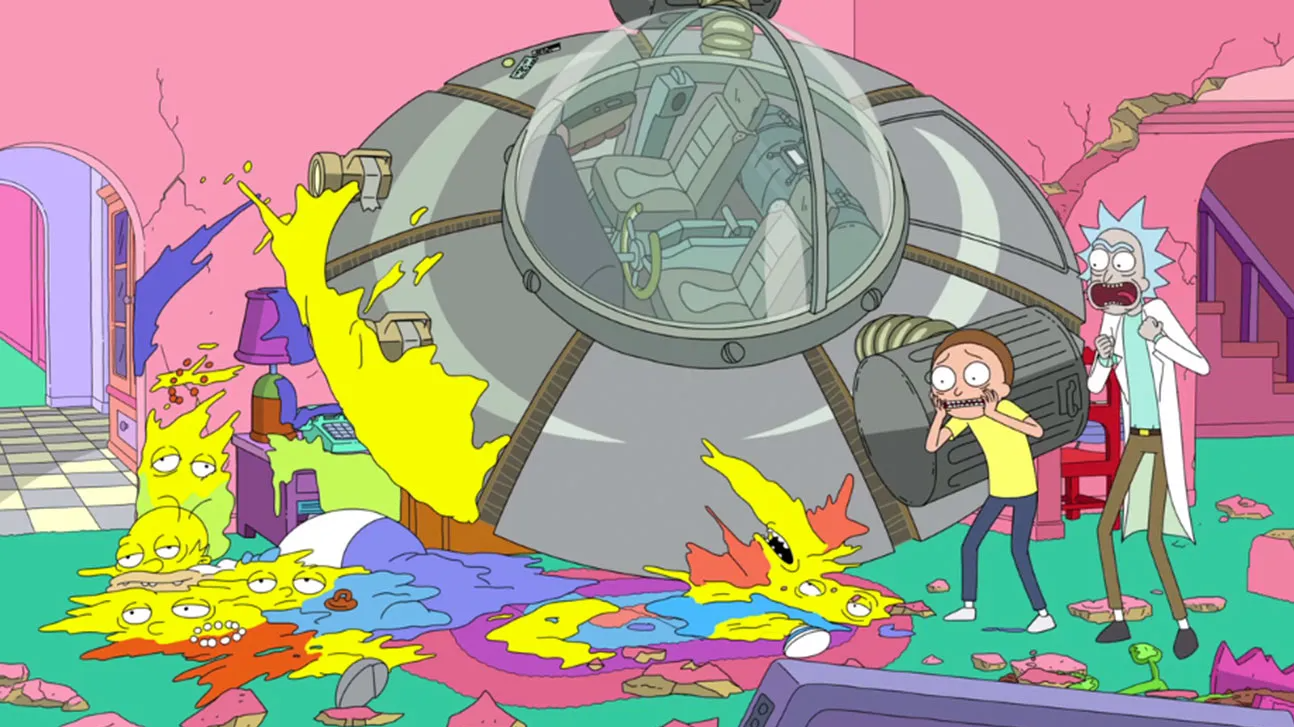
S26E22 - 05/17/2015
The Clip Show Is the Point
Here’s the thing about Simpsons clip shows that most people miss.
They’re not lazy. Well — okay, they were originally conceived as a way to save budget. But structurally, what a clip show does is reveal patterns across episodes that you couldn’t see when you were watching them one at a time. The couch becomes a vantage point. You see the through-lines. You see that Homer’s relationship with Lisa has been the emotional core the whole time. You see that the town’s collective stupidity isn’t random — it’s systemic. The clips, removed from their original context and placed side by side, create meaning that wasn’t visible in any single episode.
That’s what I just did (I think). But I might have done it in reverse with the windows down. I do apologize if anything got wet. You have insurance right? Same stuff that covers intellectual whiplash probably. If not, I really recommend it.
That’s Gonzo Intellectualism. I just didn’t have a name for it until today. Well, to be honest, this piece took a few days of poking and prodding so I have had the name for a little longer than I wrote. But that is because I wrote it a few days ago. That’s still honest, right? As long as I am transparent?
Thompson didn’t decide to invent Gonzo Journalism. He wrote the Kentucky Derby piece, the editor ran it, and people said: what do we call this? The label came after the practice. That’s how this works. I think that is how all of it works. You don’t design a style. You do the work honestly, you create authentically, and the style reveals itself.
I’ve been doing Gonzo Intellectualism this whole time. I just finally caught it and put a handle to it. You can call it something else. It doesn’t change what I am doing.
What’s Next
If you’re new, welcome. You’re nowhere near caught up now, but don’t worry, I think that is the point. Now perhaps you have the map. The pieces I described above are all available. Read them in any order. They’re designed to work independently, but they resonate (there’s that word again) differently when you see them together. Like episodes of a show. Like songs on an album. Like clips on a couch. There are many layers, you will catch new things on each review.
If you’ve been here a while, now you have a name for what you’ve been watching.
And if you’re someone who’s been doing this too — thinking in public, showing the mess, refusing to perform expertise, being dead serious while absolutely refusing to be serious — then you’re doing Gonzo Intellectualism too. You just didn’t know it had a name either.
Now it does. I hope it catches on.
The only certainty is uncertainty.
Update 04/27/2026: NotebookLM now has ‘cinematic’ explainers. This is super cool. Here is one on this article:
Sources
- Daniel Grey, “Relational Machines,” The Indeterminate Reality (Substack), 2024. https://tiocs.substack.com/p/relational-machines
- Daniel Grey, “The Architecture of Scientific Stagnation,” The Indeterminate Reality (Substack), 2026. https://tiocs.substack.com/p/the-emotional-architecture-of-scientific
- Daniel Grey, “The Architecture of Intellectual Retreat, Part Two,” The Indeterminate Reality (Substack), 2026. https://tiocs.substack.com/p/the-architecture-of-intellectual-140
- Daniel Grey, “The Architecture of Intellectual Retreat, Part One,” The Indeterminate Reality (Substack), 2026. https://tiocs.substack.com/p/the-architecture-of-intellectual
- Daniel Grey, “Reference Frames as Vectors: A Resonance Geometry Approach,” The Indeterminate Reality (Substack), 2026. https://tiocs.substack.com/p/reference-frames-as-vectors-a-resonance
- https://substack.com/@tiocs/note/c-239431082
- Daniel Grey, “Anthropocentric Bias,” The Indeterminate Reality (Substack), 2024. https://tiocs.substack.com/p/anthropocentric-bias
- Daniel Grey, “An Experiment on Events and Relations,” The Indeterminate Reality (Substack), 2026. https://tiocs.substack.com/p/an-experiment-on-events-and-relations
- Daniel Grey, “The Cosmic Instrument,” The Indeterminate Reality (Substack), 2025. https://tiocs.substack.com/p/the-cosmic-instrument
- Daniel Grey, “It’s Done When It’s Done,” The Indeterminate Reality (Substack), 2026. https://tiocs.substack.com/p/its-done-when-its-done
- Thompson, H. S. (1998). Fear and loathing in Las Vegas: A savage journey to the heart of the American dream (2nd Vintage Books ed). Vintage Books.
For More Information:
[1] J.-P. Sartre, Existentialism is a Humanism (1946).
[2] W. Farnsworth, The Socratic Method: A Practitioner’s Handbook (2021).
[3] Plato, The Last Days of Socrates (Penguin, 2003).
[4] D. Kahneman, Thinking, Fast and Slow (Farrar, Straus and Giroux, 2011).
[5] D. Kahneman, Noise: A Flaw in Human Judgment (Little, Brown, 2022).
[6] J. Olstein, Mastering Logical Fallacies (Zephyros Press, 2016).
[7] N. Doidge, The Brain That Changes Itself (Viking Press, 2007).
[8] C. S. Dweck, Mindset: The New Psychology of Success (Random House, 2006).
[9] K. Friston, The free-energy principle: a unified brain theory? Nature Reviews Neuroscience 11, 127–138 (2010).
[10] L. Feldman Barrett, Seven and a Half Lessons About the Brain (Houghton Mifflin Harcourt, 2020).
[11] D. D. Hoffman, The Interface Theory of Perception.
[12] P. Walker, Complex PTSD: From Surviving to Thriving (Azure Coyote, 2013).
[13] B. van der Kolk, The Body Keeps the Score (Viking, 2014).
[14] M. Wolynn, It Didn’t Start with You (Viking, 2016).
[15] E. Vora, The Anatomy of Anxiety (Harper Wave, 2022).
[16] J. Metcalfe & A. P. Shimamura (eds.), Metacognition: Knowing About Knowing (MIT Press, 1994).
[17] D. J. Siegel, Aware: The Science and Practice of Presence (TarcherPerigee, 2018).
[18] R. J. Davidson et al., Impact of short- and long-term mindfulness meditation training on amygdala reactivity to emotional stimuli. NeuroImage (2018).
[19] A. Lutz et al., Neural correlates of attentional expertise in long-term meditation practitioners. PNAS (2007).
[20] M. Balaguer, Free Will (MIT Press, 2014).
[21] K. J. Mitchell, Free Agents: How Evolution Gave Us Free Will (Princeton, 2023).
[22] T. Kuhn, The Structure of Scientific Revolutions (U. Chicago Press, 1962).
[23] P. Thagard, Energy Requirements Undermine Substrate Independence and Mind-Body Functionalism.
[24] T. Hunt & J. W. Schooler, The Easy Part of the Hard Problem: A Resonance Theory of Consciousness (2019).
[25] R. Descartes, Meditations on First Philosophy (Oxford, 2008).
[26] F. Faggin, Irreducible: Consciousness, Life, Computers, and Human Nature (2024).
[27] S. Sarkis, Gaslighting (Da Capo, 2018).
[28] H. Reichenbach, Philosophic Foundations of Quantum Mechanics (1944).
[29] H. Reichenbach, The Principle of Anomaly in Quantum Mechanics. Physical Review (1948).
[30] E. Ostrom, Collective Action and the Evolution of Social Norms (2000).
[31] J. B. Glattfelder, The Emergence of Trust and Ethics.
[32] J. B. Glattfelder, Information—Consciousness—Reality (Springer, 2019).
[33] C. G. Jung, Archetypes and the Collective Unconscious (Princeton, 1990).
*The sources I provided are not what I used to write this essay. This is pretty much the same list as before. This list I am going to carry over, and it will change over time, as it is pretty much a list of what I am currently reading, and thus is at the forefront of my thinking. Like my music selection, which is next.
Currently Resonating:
- Samurai Pizza Cats — “Ramen-Man” feat. BABYBEARD — Press Start, 2026. German party metalcore (?) with a name that dares you to take them seriously. You won’t. You should though. Electric Callboy’s spiritual cousins. The Simpsons energy — absurdity as delivery system for something that actually rips.
- The Dear Hunter — “In Cauda Venenum” — Act III: Life and Death, 2009. Part of a multi-album rock opera. The title is Latin for “poison in the tail.” Prog storytelling where the structure is the narrative. Casey Crescenzo built something across albums that only reveals its shape when you step back and see it all at once. Beautiful writing. They embody it so well for something that was a side project.
- August Burns Red — “The Nameless” — Season of Surrender, 2026. Metalcore that has been excellent for two decades. The title is the point. Sometimes the thing that matters most hasn’t been named yet. They sound so angry, yet, their message is one of pure positivity. Let that sit. Can’t wait for this album to come out (June 5th!)
- vianova — “Oh No (Ando San Remix)” — 2025 single. This collab is really cool. This band has made it their mission to ‘never write the same song twice’. And they deliver. As everything they do is a choice, and one they somehow pull off very well. I have dubbed it a new genre- Groovecore (we will see if it catches on).
- NEMOPHILA — “PROGRESS” — Apple of my eye, 2025. Japanese metal band I just found. The way these women write, they are fierce, and I am sad I did not come across them sooner, but here we are. Just pure awesome so far.
- Bring Me the Horizon — “Kingslayer” feat. BABYMETAL — POST HUMAN: SURVIVAL HORROR, 2020. The transformation of this group from Deathcore to a pop metal sensation is incredible. And then combine it with BABYMETAL and you have something I can't get out of my head. If you think about it, it shouldn’t work, but it does. And they do it spectacularly.
- Bury Your Dead — “Minority Report” — We Are Bury Your Dead, 2019. Massachusetts Hardcore. The grooves they put out are visceral, intense and brutal. When you are feeling angry and want to break stuff, these guys are a must. Also, most of their songs are named after Tom Cruise movies. I find that hilarious.
- Mr. Bungle — “Carousel” — Mr. Bungle, 1991. Genre shifts mid-sentence. Ska into metal into circus music into something with no name. The clip show of songs. The history of this group is just as weird as the music they produce.
- WIZO — “Quadrat im Kreis” — Fat Music Vol. IV: Life in the Fat Lane, 1999. German punk. I have loved this song for decades. It is beautiful. I looked up the meaning when I was younger. I should do it again soon as I don’t speak German fluently.
- The Brecker Brothers — “Some Skunk Funk” — Heavy Metal Be-Bop, 1978. Jazz fusion that earned the “heavy metal” in its album title through using distortion on a trumpet and saxophone. It had not been done like this before. Technical mastery as groove. Proof that rigor and fun are not opposites. Never were.
Related Pages
No other pages link to this page.