Skip to content

November 2024

Anthropocentric Bias

Blog Header "Human beings are the only creatures on earth that claim a God and the only thing that behaves like it hasn’t got one.” ― Hunter S. Thompson"

Here’s a fun topic: anthropocentric bias. Basically, it’s our tendency to think humans are somehow the main characters of the universe’s story. It shows up in a bunch of ways: perceptual, descriptive, and normative. Perceptual anthropocentrism is pretty straightforward—we can only understand the world through our human senses, right? What we can see, hear, touch, taste, and smell. Descriptive anthropocentrism is when we try to explain everything in human terms (ever caught yourself thinking your dog is giving you the silent treatment?). And then there’s normative anthropocentrism, where we just assume humans are better than everything else, full stop.

Why does this matter? Because it skews our understanding of reality. If we want to truly understand the world, independent of ourselves, we need to account for these biases rather than unconsciously impose them on everything we study. This isn’t a critique of humanity—far from it. I have a soft spot for humanity myself. But to uncover how things actually work, we need to temporarily remove ourselves from the center of the equation.

This isn’t some new problem we’ve just discovered. Hans Reichenbach, in his book called The Rise of Scientific Philosophy, critiques anthropocentric tendencies as they appear in the philosophical traditions of thinkers like Plato. Plato’s theory of forms, for instance, posits that there exists a singular, perfect form for every imperfect object we encounter in the world. Reichenbach, however, calls this poetry rather than explanatory. He argues that such pseudo-explanations—appeasing our desire for knowledge with pretty analogies instead of well-defined, evidence-based concepts—aren’t science. There is nothing wrong with that if you don’t need to care about science- but if your livelihood depends on it, function over form is what will matter.
Quantum Weirdness

Blog Header "But I think that ideas are dangerous and powerful things, and that even philosophers have sometimes produced ideas.” ―Karl Popper, Conjectures and Refutations"
I came across a fascinating article titled How to Make Peace with the Weirdness of Quantum Mechanics by Big Think. Overall, I think it’s an excellent rundown of the counterintuitive nature of quantum mechanics and its divergence from classical intuition. However, one passage stuck out to me, prompting a deeper reflection.

If you believe this line of thought is useful, you’ll answer, “Who knows; let’s try to find out.” But if you’re like me, you’ll think this line of thought offers no knowledge and is a dead end. Unless you can find an experimental benefit of one interpretation over another — unless you can test them against each other in some sort of laboratory setting — all you’re doing in choosing an interpretation is presenting your own human biases. If it isn’t the evidence doing the deciding, it’s very hard to argue that there’s any scientific merit to your endeavor at all.

This struck me because it reveals a very particular, and I’d argue overly narrow, definition of knowledge. If knowledge is strictly defined as immediately testable or directly practical, then yes, speculative ideas can seem like dead ends. But knowledge, in my view, is far broader. It doesn’t always have to be scientific or practical to hold value. Speculative frameworks—those that may seem useless or untestable at first—can still shape future exploration.

Relational Machines

Blog Header "The true sign of intelligence is not knowledge but imagination.” ― Albert Einstein"
I want to challenge you. I want to challenge your assumptions about what you think you know about artificial intelligence.

First, let’s start with this: artificial intelligence has been around for a very long time. The concept and its implementation go way back—think Pong, or even earlier. If you remember the Atari, the Commodore 64, or any of those early consoles or computers, you probably played some of those old games that had artificial intelligence. And there’s something about AI in video games that I’ve always found fascinating. It almost feels like it’s thinking on its own, more than we might realize—or at least, that’s how it seems to us.

When I was in school, studying computer science, I learned something surprising about AI, at least in video games. The best artificial intelligence—the kind that feels realistic—was usually incredibly simple. The more complicated it got, the less believable it became. It was simple elements, working together, that created this emergent behavior. Something that seemed greater than the sum of its parts. And maybe it was.

The Struggle of Ambiguity

Blog Header "The art of discovery is therefore the art of correct generalization.” ―Hans Reichenbach, The Rise of Scientific Philosophy"
I’ve spoken a lot about uncertainty and the incredible beauty it brings to reality thus far. But let’s be honest: we can’t live in a world of complete and utter uncertainty all the time. There has to be something to hold on to. I’m not saying objectivity doesn’t exist—it does. It’s just not what we thought it was.

The world hasn’t changed; only our understanding has. Everything we know is still there—it’s just reframed. Yet humans often act as if the moment our understanding shifts, reality itself has shifted. We confuse the change in our perception with a change in the world. But if we discover that something we thought was solid isn’t solid, the truth is it was never solid to begin with. It didn’t suddenly become unsolid; we simply misjudged it.

This need to pin things down, to master and control reality, feels like a form of hubris. It’s a kind of anthropocentric bias—the belief that we, as humans, are the only beings of consequence in the universe. This isn’t an objective fact I’m presenting—it’s an opinion, yes, but one informed by decades of observing, thinking, and questioning.

Embracing Uncertainty

Blog Header "“But what does a particle care if we are observing it or not?” ― Carlo Rovelli, Helgoland"
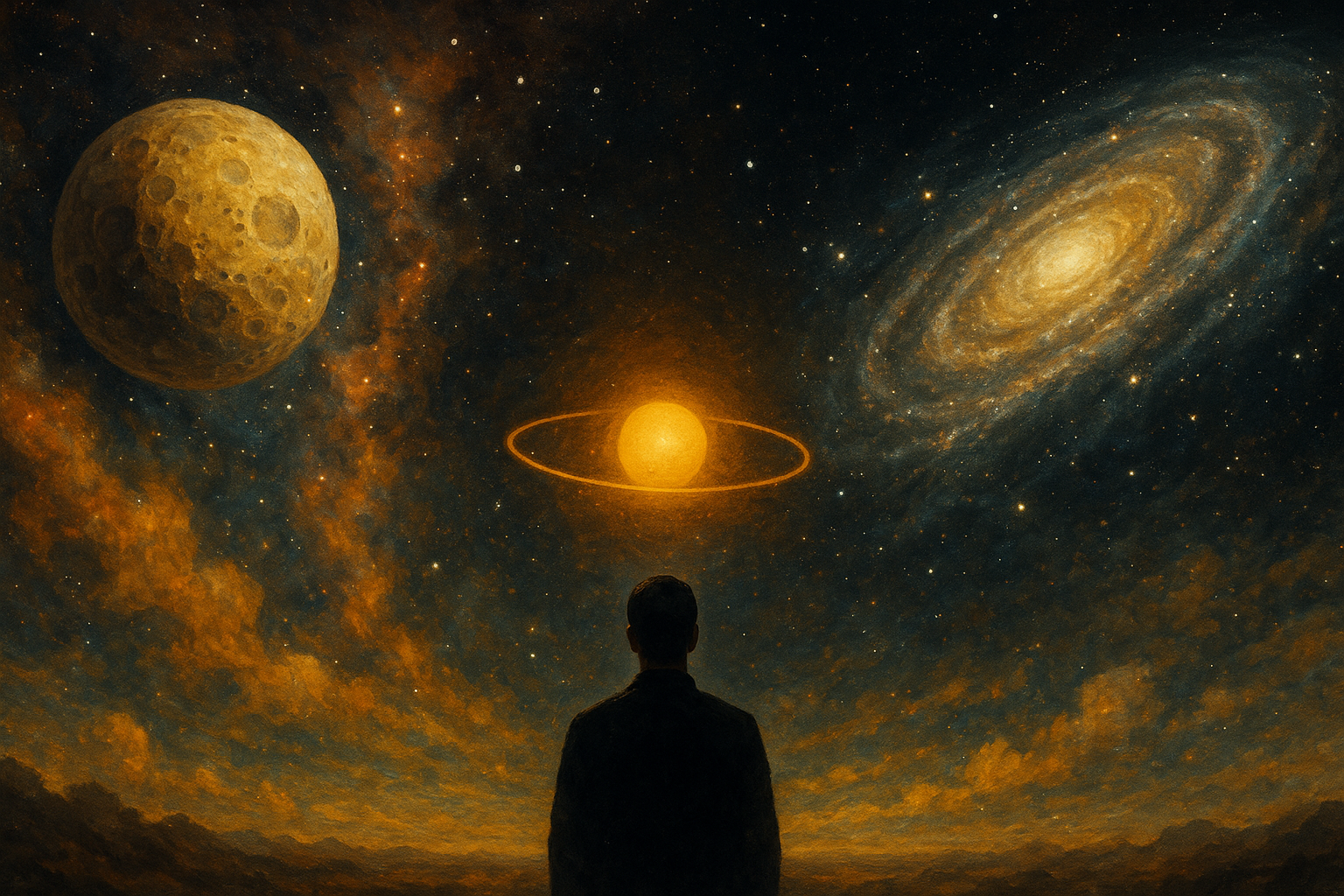
The interconceptualist mindset and philosophy start with a simple, profound idea: the only certainty is uncertainty. This saying, derived from Socrates and the Heisenberg Uncertainty Principle, embodies the humility that sits at the heart of both philosophy and science. If you’re unfamiliar with either- don’t worry, we have your back. Known as one of the founders of philosophy and scientific thought, Socrates approached the world with rigorous logic, relentless questioning, and boundless curiosity.

While the Heisenberg Uncertainty Principle deals with indeterminacy in the world of physical science- Socrates deals with the subjective uncertainty that we have in our everyday existence. Let’s focus on the subjective for now, and dive into the world of Quantum Mechanics another time.

What’s fascinating about Socrates is that he didn’t write anything down himself. Everything we know about him comes to us through Plato. There’s even disagreement over whether Socrates was entirely real, or where Socrates ended and Plato began. Many philosophers believe Plato eventually used Socrates as a kind of puppet to push his own ideas. This uncertainty over Socrates’ existence mirrors the very idea he is most famous for: I know that I know nothing.

The Indeterminate Reality

Blog Header "You lye, you are not sure; for I say, Woman, ’tis impossible to be sure of any thing but Death and Taxes“―Toby Guzzle, The Cobbler of Preston"
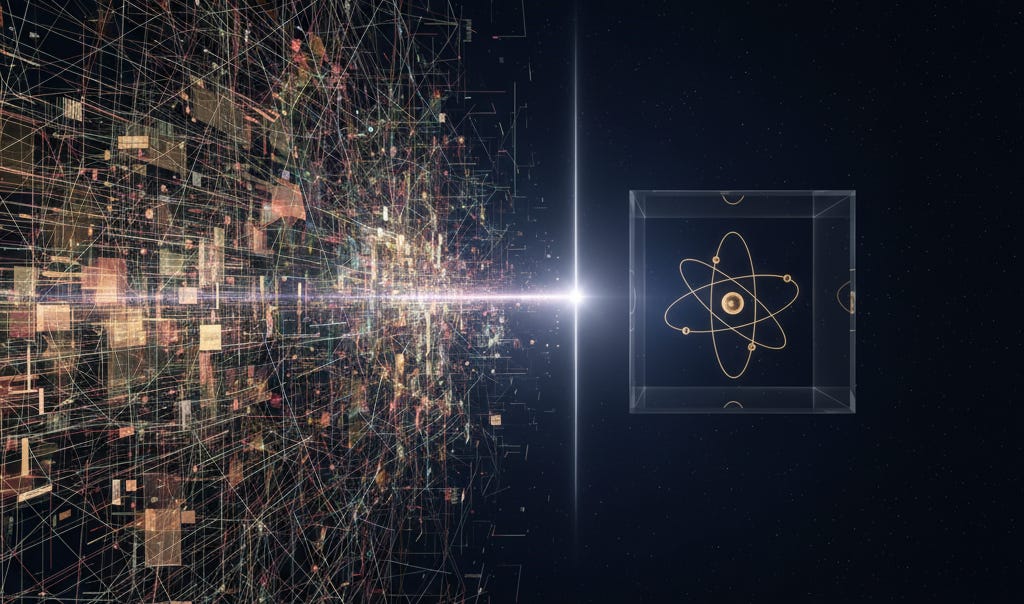
The only certainty is uncertainty. From Socrates, we learn that our subjective experience cannot be fully trusted. What we see, what we perceive, is far from certain. This has been echoed not just philosophically but scientifically—through neuroscience, cognitive science, psychology, and beyond. A theme begins to emerge here, a universal principle that applies everywhere, to everything, but expresses itself in infinite ways. This diversity, this beauty, is what makes reality so remarkable. And how do we have this diversity? How did we get it? It springs from the indeterminacy woven into the very fabric of existence.

Since the early 1900s, with the birth of quantum mechanics, humanity’s understanding of the cosmos has undergone profound shifts. There have been moments throughout history where we’ve had to reorient ourselves in the universe—this was one of those times. And it came in the shadow of Albert Einstein’s revolutionary theories of general and special relativity, which had already redefined our understanding of space, time, and reality itself.

Relativity gave us a deterministic view of the cosmos. Everything in the universe, from the orbits of planets to the trajectory of comets, seemed predictable, determined by prior causes. This deterministic framework, which had guided humanity since Newton, told us that if we could know all the laws and initial conditions, we could predict everything that would ever happen—like a line of dominoes falling, one after the other.

Clarity in Complexity

Blog Header "Any definition of complexity is necessarily context-dependent, even subjective.” ― Murray Gell-Mann, The Quark and the Jaguar"
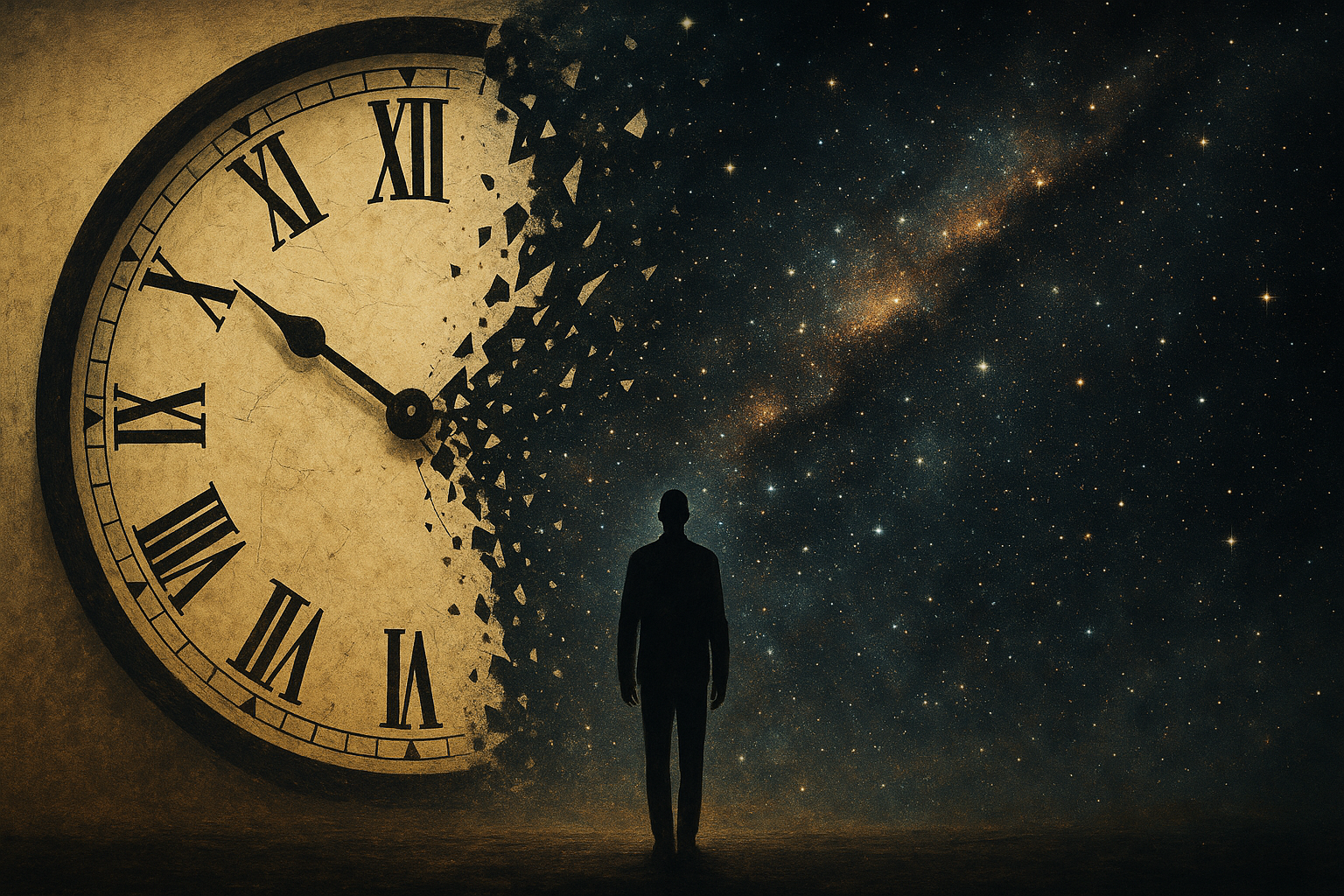
Spoilers- we’re going to dive into some deep and challenging ideas. Complexity, by its very nature, can feel overwhelming. It’s messy, multifaceted, and often defies simple explanations. And yet, it can also be incredibly elegant—so elegant, in fact, that it becomes confusing in its abstraction. My goal here isn’t to shy away from that complexity, nor is it to oversimplify. Instead, I want to distill these ideas, presenting them as clearly as possible—even if that means repeating myself along the way.

Albert Einstein’s approach resonates with me deeply. When he introduced Relativity: The Special and General Theory to the public in 1920, he didn’t shy away from the inherent difficulties of his subject. Instead, he emphasized clarity over elegance, following the advice of the brilliant physicist L. Boltzmann: “Matters of elegance ought to be left to the tailor and the cobbler.” Like Einstein, I’d rather take the time to repeat myself, adding layers of clarity and accuracy, than prioritize form over function. Complexity is relative, after all. What’s complex to one person may seem intuitive to another—and what’s challenging now may cease to be once it becomes familiar.

To make sense of complexity, we must be willing to engage with subjectivity. Simple systems, like deterministic ones we can easily predict, are more objective. They operate in ways that seem context-independent, requiring no additional layers of meaning or interpretation to function or be understood. But complexity? Complexity demands context—it thrives on it. And because context varies, complexity becomes subjective.

Out of Time

Blog Header "“You see things; you say, ‘Why?’ But I dream things that never were; and I say ‘Why not?”_ ― George Bernard Shaw, Back to Methuselah"

There’s a peculiar tension in feeling “out of time.” It’s not about being ahead or behind—it’s about moving to a rhythm that others don’t seem to hear. For as long as I can remember, I’ve felt this way: slightly out of sync, like a note in the wrong key or a shadow cast by a light that hasn’t quite reached its source.

This dissonance isn’t random. It stems from a philosophy I’ve carried with me my entire life. At its core is a single guiding principle: the only certainty is uncertainty. This idea, merging the Socratic mantra “The only thing I know is that I know nothing” with Heisenberg’s Uncertainty Principle, has shaped the way I see and engage with the world. It’s a mindset that refuses to settle for absolutes, embracing paradox and provisional truth instead.

Over the past ten months, this philosophy has crystallized into something larger, guided by relentless curiosity and a desire to understand the deeper patterns of reality. I’ve explored ideas that challenge traditional frameworks, weaving concepts from numerous disciplines into a cohesive mental model of reality. It’s been thrilling, humbling, and terrifying all at once.