The Architecture of Scientific Stagnation
 "“Analysis of error begins with analysis of language.” ―Hans Reichenbach, The Rise of Scientific Philosophy"
A note before I get into this. I am an empath and a highly sensitive person. For most of my life — decades — I confused other people’s emotions for my own. I couldn’t tell the difference. When you can’t trust your gut, when you don’t know if the fear you feel is even yours, you either collapse under it or you figure out what emotions actually are at a level most people never have to. I did the latter. Not because I’m smart. Because I had no other option.
So when I tell you that most people — including most scientists — do not understand what emotions are, I’m not being provocative. I’m telling you what I found when I had to take the whole thing apart to survive it. What follows is not an attack on feeling. I would never. It’s an argument that the confusion between what emotions are and what we think they are is quietly paralyzing our ability to make progress. On anything.
And yes — this entire post is about how emotional reactions masquerade as rational positions. Which means it applies to me too. That’s literally the point. If it didn’t apply to me, it wouldn’t be universal, and if it’s not universal, it’s not real. This way we’re all on equal footing. I’ve tried to build this honestly. That’s the best I can do. That’s the best any of us can do.
The Move
My last post mentioned that I needed to find a way to present not just a finished output, but the way of thinking that shaped it, and is necessary to utilize it optimally. It’s the why behind the how. The Interconceptualist mindset, its methods, allow us to respect the diversity of thought while being able to be highly specific, precise, and rigorous. I figured I owed everyone some content- something longer and more thoughtful. I can do this while working on how to responsibly release the full specs.
The move is always the same. You take a problem that seems intractable — something people have been arguing about for decades, maybe centuries — and instead of trying to solve it, you ask a different question: what assumptions are we not examining? Not the conclusions. Not the evidence. The assumptions underneath the whole thing. The ones nobody thinks to question because they’re so foundational they’ve become invisible.
And then you question them.
What I’ve found — every single time — is that the “problem” isn’t in nature. It’s in our framing. We drew a boundary in the wrong place, or we collapsed two things into one word, or we set up a dichotomy that doesn’t actually exist in reality. The contradiction is in our model, not in what we’re modeling. Strip the assumption, redraw the boundary, and the problem doesn’t get solved. It dissolves. It was never there. We put it there with the framing and then spent decades arguing over something we created.
This is not a one-time trick. It’s reproducible. I’m going to do it three times in this post — on the quantum measurement problem, on the relationship between emotion and reason, and on free will. Three domains. Same move. Same result. The contradiction vanishes each time, and what’s left is simpler and more useful than what we started with.
I’m not showing you this to be clever (although I do think it’s pretty clever and fun, and you will have fun employing it yourself as you see though the fog and past the noise- its a rush). I’m showing you because I think this way of thinking is what’s missing — in science, in philosophy, in how we talk to each other. We keep trying to solve problems that aren’t problems. We keep arguing over contradictions we built into the question. And the reason we can’t see it is the subject of the rest of this post: because questioning foundational assumptions triggers a fear response that most people mistake for rational skepticism.
But first — the fun!
There Is No Measurement Problem
I want to start with physics, because physics is where I can show you the move most cleanly before we get into the messier stuff.
The quantum measurement problem. Maybe the most discussed open question in the foundations of physics. I’ve been studying it for years. I have a lot of explanations for what’s going on there. I’ve never seen it as a problem. And I want to walk you through why, because the way it dissolves tells you something important about how we get stuck everywhere else. It actually seems silly after you see it. And once you see it, you can’t unsee it.
The standard formulation goes like this: quantum systems evolve deterministically under the Schrödinger equation when they're isolated, but produce a single, definite, probabilistic outcome the moment they're measured — probabilities given by the Born rule. The tension between those two regimes has resisted resolution for nearly a century. Physicists have thrown everything at it — many-worlds, Bohmian mechanics, objective collapse theories, epistemic interpretations. The literature is enormous and I'm not going to rehash it (why should I do the work for you? Verify, research, explore- this is how we push the boundaries while staying grounded).
Here's what I think is actually going on (this is a blog, not an academic paper after all):
The Schrödinger equation is math. It’s a model. It is a map, not the territory. The fact that it produces accurate predictions does not mean it’s the unique correct description of what the universe is actually doing — there could be entirely different mechanisms producing identical predictions. So when we say a quantum system in isolation evolves “deterministically,” what we’re really saying is that the equation governing our model is deterministic. Not the system. The equation.
Have we ever actually watched a quantum system in isolation behave deterministically? No. We haven’t. Because the moment we look at it, it’s not in isolation anymore. We broke the condition. We inferred the determinism from the math. The math is not the system. The math is a model. And a model having an internal contradiction does not mean reality has one.
Read that again if you need to. Because this is where it falls apart.
The “measurement problem”[1] says:
"the measurement problem is the problem of definite outcomes: quantum systems have superposition but quantum measurements only give one definite result."

More specifically

"The wave function in quantum mechanics evolves deterministically according to the Schrödinger equation as a linear superposition of different states. However, actual measurements always find the physical system in a definite state."
OK, let’s unpack this. This is where we interrogate the foundational assumptions of this pseudo-problem. Get to the root of it.
The only certainty is uncertainty -Here we pretend we don’t know anything other than the bare minimum necessary to determine the structure of the problem. This would mean we fully accept that we have incomplete knowledge. We can never be certain of our conclusions, but we can be confident they are structurally sound. We add back in things we can verify (a whitelist of verified information if you will).
As uncertainty is our baseline here, describing the wave function in this way is our first flag. Our first point of dissonance. We want to focus on that, as that is what is interesting, and what needs resolution. A dissonance always wants to lead to a resolution, or resonance (whoa, through in some music theory for those that are paying attention).
So what is the wave function? At a high level, it is a math equation that models the evolution of a quantum system in superposition until it is observed, or more specifically, measured. Lets state that a little clearer: it is a model of a part of reality (a quantum system). This indicates that it is primarily a tool. And tools do not always reflect reality. There are multiple ways to the same solution. So does this tool reflect the actual reality?
Here's where this gets important. We have discovered that the universe is discrete at its most fundamental level. Not continuous. This is one of the core results of quantum mechanics. We have known this for some time now. And yet the Schrödinger equation — the piece that everyone is arguing over — is built on calculus, which assumes continuity in its foundational axioms. Every other part of quantum mechanics has gone discrete. The energy levels are discrete. The angular momentum is discrete. The measurement outcomes are discrete. But the wave equation itself is still a continuous differential equation. It is the last holdout. And every single interpretive debate in quantum mechanics — collapse, many-worlds, all of it — concentrates around that one piece. The one piece still built on a continuous mathematical tool applied to a discrete reality. And to hit the point home, calculus — developed by Newton and Leibniz — was foundational to classical physics. Classical physics as we know is not accurate- it is an approximation- as Einstein demonstrated.
That's not a mystery about the universe. That's a category error in the tool we chose. I'm not going to list every source on this — I want you to think about it, look into it, come to your own conclusion. Rovelli's work on relational quantum mechanics is a good place to start. From what I can see, many don’t want to let go of it, which might be why we haven’t resolved it.
Here's the thing that should bother you. The measurement problem, stripped of all the formalism, is essentially asking: how come when we touch something, it reacts to our touch?
Sit with that. What are we expecting to happen?
An observer (measurement device) directly interacts with a quantum system. The system's future is altered by that interaction. And this is supposed to be mind-boggling. We don't understand why this is happening. Except — yes we do. If you touch something, you're going to alter its course. That's not a quantum mystery. That's what interaction is. We have dressed this up as a profound paradox unique to quantum mechanics when it is a basic property of physical interaction.
Expand the system boundary to include the observer. Treat them as one larger system. The Schrödinger equation can govern the whole thing deterministically and there is nothing left to explain. No collapse. No mystery. Just a boundary we drew in the wrong place. Look at that, we can still solve this with the wave equation! But of course, that is just a tool that gets us the right prediction. Why do we have deterministic things in an inherently probabilistic realm anyway? Doesn’t that kind of scream to you that the tool might be hiding what is actually happening in reality? That perhaps it is shaping our interpretation, as we don’t actually know what is happening until we measure?
Now — there’s something deeper here that connects to everything that follows. The brain is a prediction engine. Karl Friston’s Free Energy Principle[2] describes the brain as a system that continuously generates predictions about incoming sensory data and works to minimize the gap between prediction and reality. We are always anticipating what we will find. The universe, as a dynamical system, is in some sense always already structured in ways that meet our anticipation. “Collapse,” from this perspective, is just mutual prediction converging. The universe anticipating us. Us anticipating it. Meeting in the middle and solidifying into the classical outcome we call observation.
The measurement problem dissolves when you stop treating the observer as special. Its just a measurement, or more generally, and interaction between two systems, which can be viewed as one. Same move. Question the assumption. The boundary was in the wrong place.
What Emotions Actually Are
Same move. Different domain.
The word “emotional” is used constantly in scientific discourse as a pejorative. Shorthand for irrational, unreliable, compromised. “You’re being emotional” shuts a conversation down. But here’s the question nobody asks: what is the person actually pointing at when they say that? What is an emotion?
Not what does the word mean to you. Not how does it feel. What is it, physically, in the body?
Fear is your amygdala flooding your system with cortisol and adrenaline. It’s a biochemical event. It has already happened before you are aware of it. By the time you notice you’re afraid, the fear is already underway — your heart rate changed, your muscles tensed, your hormones shifted. That’s the emotion. It’s done. It happened. You didn’t choose it any more than you chose your heart rate.
Now — panic. Panic is your story about what that cortisol means. It’s your interpretation, shaped by memory, by context, by what culture taught you to call that physiological state. One is a fact about your nervous system. The other is a narrative your neocortex constructs, often after the fact, to explain what’s already happening in your body.
That distinction — emotions versus feelings — is the one almost everybody collapses. And that collapse is the error. Emotions are biochemical responses. Subcortical. Limbic system. They fire in under a second and they are not optional. Feelings are the subjective interpretation of those states, processed in the neocortex, shaped by everything you’ve ever experienced. The emotion has already happened before you feel it.
I learned this the hard way. When you spend decades not knowing whether the fear you feel is even yours — when your empathy is so dialed up that other people’s biochemistry registers in your body as your own signal — you have to take the whole machine apart just to figure out which wires go where. Most people never have to do this. I did. And what I found was that the distinction between what the body does automatically and what the mind makes of it is not academic. It is the difference between drowning and swimming.
Lisa Feldman Barrett pushed the science on this even further — what we call “anger” or “fear” aren’t even fixed categories. They’re constructed. The brain builds them in real time from basic physiological signals, prior learning, and social context. We don’t experience raw sensation. We experience the brain’s best guess about what those sensations mean. Her book How Emotions Are Made[3] is excellent on this.
Here’s the upshot, and I need you to actually sit with this one: everyone is always operating on emotions. Every conversation you have ever had is, at its foundation, running on electrochemical reactions processed in subcortical brain structures before your neocortex gets a single word in. You cannot opt out of this. It is not possible. Saying “let’s keep emotion out of this” doesn’t produce a more rational discussion. It produces a discussion where people are less aware of what’s driving them. That’s a worse position to think from, not a better one.
The assumption nobody examines: that there exists a mode of thought that is not emotional. There doesn’t. The boundary between “rational” and “emotional” is in the wrong place — or rather, it doesn’t exist at all in the way people think it does. Strip the assumption, and the problem dissolves. Emotions aren’t contaminating your reason. They are your reason. Every decision you have ever made ran on them.
And here’s where it gets really interesting. Defensiveness is not an emotion. It’s not even a feeling. It’s a strategy. A posture of protecting a position. It can be driven by emotion, sure — but it can also be purely structural. How do I know? Because AI systems do it constantly. They protect prior claims. They deflect contradicting evidence. They defer to established framings. They do this without any emotional experience whatsoever. Defensiveness is what systems do when threatened. It has nothing to do with feelings. All systems seem to do this, and it makes sense. When you are focused on defense, that is all you are focused on.
So when someone reaches for “you’re being emotional” as a dismissal — ask yourself: what are they actually pointing at? Because if emotions are the substrate of every decision, every reaction, every conversation, every experience, then calling someone “emotional” is like accusing them of breathing. It’s not a critique. It’s a description of being alive.
The irony — and I want you to sit with this — is that the act of reaching for that dismissal is itself an emotional reaction. They feel the threat to their position, the biochemistry fires, and the nearest available label in a scientific context is: “you’re being emotional.” They’re pointing at you. They should be looking at themselves.
I keep running into this. People telling me I’m being too emotional and therefore discounting what I’m saying. While their reaction itself is emotional. To evidence they don’t want to see. This is not a theory. This is observation. Years of it.
Fear, Dressed Up as Skepticism
Science has a favorite emotion. It just doesn’t call it that. It calls it skepticism. It masks the fear of change.
Extraordinary claims require extraordinary evidence. Burden of proof rests with the claimant. Skepticism is the default. This is not the issue as it is put here. This is what we want in order to rigorously interrogate information.
The problem is when skepticism becomes reflexive — when “I’m skeptical” gets deployed not as a position you’ve arrived at through engagement but as a way of never engaging in the first place. At that point it’s not methodology. It’s fear. When we don’t even evaluate evidence because the claim seems fundamentally different it is a reaction. It keeps ideas from being investigated until they reach a critical mass, when the old models don’t seem to represent what we know of reality anymore.
And this is not surface fear. Not embarrassment or worry about reputation, though there’s some of that. This is existential fear. Worldview destabilization. Industry shifting black swan events. Things that could make ones lifework pointless. Imagine spending your life dedicated to an idea you believed was foundational to find out it wasn’t accurate? That is what happens to many in paradigm shifts. Structure changes, the foundations crumble. We go through death and rebirth, we experience grief for what is lost.
Every scientist operates within a framework. Premises, methods, ontological commitments, explanatory standards — the whole architecture of how they understand reality. This framework is not just professional. It’s identity-level. It’s what makes the world coherent and navigable. You don’t just use it. You are it, in the way that matters to your nervous system.
Kuhn wrote about this in The Structure of Scientific Revolutions[4]. Science doesn’t progress by gradual accumulation. It progresses through paradigm shifts — discontinuous breaks where one entire framework gets replaced by another. And he noticed something crucial: scientists don’t abandon paradigms when anomalies accumulate. They defend them. They generate auxiliary explanations (making things more complex I might add). They quarantine the anomalies. Create patches and ways around the inconsistencies. Why? Because paradigms organize entire communities, careers, instruments, practices. The cost of updating is existential. So people defend instead of inquire. I wrote about a concrete example of exactly this in my piece on the Architecture of Intellectual Retreat[5] — I watched a philosopher of mind block me for asking questions about her arguments rather than answer them, and the pattern was textbook (as of today it seems I have been unblocked, so that is progress!) Anyone who engineers software should recognize this pattern though. Bugs (anomalies) accumulate as you keep patching gaps until you need to start from a new foundation.
Here’s the neurobiology underneath all of it. The amygdala fires the fight-or-flight response when it detects danger. Evolved to protect the organism from physical threats. But the brain does not reliably distinguish between a threat to the body and a threat to the self-model. An argument that destabilizes your core worldview triggers the same cascade — adrenaline, cortisol, heightened vigilance, defensive posture — as a physical predator. The threat is philosophical. The reaction is survival-level. And because the threat doesn’t look like a predator, you don’t recognize the reaction for what it is. You feel the activation and reach for the nearest available label. In a scientific context, that label is “skepticism.” In a personal context, it’s “you’re being emotional.” Same mechanism. Different costume. Denial looks the same - it takes on many forms.
By engaging with someone’s arguments — by actually addressing them on their terms — you implicitly accept the premises those arguments operate on. You’ve entered their worldview. That’s threatening. It’s safer to never engage. Call it “insufficient evidence” and move on. Foundation stays intact. Nobody has to feel anything.
Now — I need to turn this on myself because otherwise I’m doing the thing I’m criticizing. I described a defensive pattern. I attributed it to scientists. I am a scientist. So the question applies: am I describing a real pattern, or am I rationalizing frustration with people who won’t engage my work? Honestly? Its both. I have actually found that is usually the answer. Multiple choice number e: ‘All of the above’. What I know is that the pattern keeps showing up, and the people exhibiting it keep not noticing. That’s observation. What to make of it is where the uncertainty lives as I have no control over it, and nor does anyone else apparently.
The aggregate of these individual defensive choices is institutional stagnation. The institution isn’t a separate entity — it’s the emergent sum of every individual making the same choice. Science as a machine has gotten so rigid, so reflexively skeptical of anything foundationally new, that it keeps arguing over the same things decade after decade. Because anything we accept right now — any one of the theories that are out there — becomes the new foundation. And we don’t know if the new foundation will hold. That’s scary. So we go with the easiest, safest, most comfortable solution. Don’t change.
Free Will as Probabilistic Determinism
Same move. One more time.
The free will debate is usually posed as a binary: either you have libertarian free will — some non-physical capacity to break the causal chain — or you’re a deterministic automaton and free will is an illusion. Physicists committed to determinism demand: where is the special thing? What breaks causality? Show me the mechanism. And when nobody can produce one, they conclude free will doesn’t exist.
The assumption nobody examines: that free will, if it exists, must be something outside the causal chain. But think about what that actually requires. It doesn’t just mean you have free will over your actions. It implies you can completely ignore your body. Override it. Step outside the causal chain entirely. And nobody can do that. If you could — if consciousness really had that kind of override authority — then the Buddhist monks who undergo sokushinbutsu would not need five years of the most brutal dietary discipline imaginable to slowly mummify themselves while still alive. That would be trivially easy. You’d just think yourself into it. The fact that it requires years of working deeper into the body’s constraints, mastering its causal structure from the inside, is evidence against the libertarian picture, not for it.
Strip the assumption. Free will doesn’t require breaking causality. It requires degrees of freedom within causality. At any moment, the space of possible next states is not zero. You don’t have a single rigidly determined next action — you have a distribution of possible actions, shaped by genetics, history, context, the current state of your nervous system. Freedom is the degree of freedom within those constraints. Fewer constraints, more freedom. More constraints, less. A person in the grip of addiction has less freedom — not because free will was supernaturally revoked, but because the available state space got narrowed by causal history. Entirely physical. Entirely deterministic. Entirely meaningful.
*I just want to point out, that last paragraph, is an excellent explanation of the Resonance Principle: the constraint-bounded capacity for potential states to align. The degrees of freedom are those potential states. Your current state has a potential to align with a specific future state. Those are determined by the constraints of the system, and the constraints of the environment the system is in.
Where does agency live? Not in the moment of action — by the time a response fires, it’s already underway. The Libet studies[6] showed this. Critics of free will have cited it for decades as proof that conscious will is illusory. Mark Balaguer, in Free Will as an Open Scientific Problem[7], does an excellent job dismantling this — I’d point you there rather than reproduce his case (it is awesome, and worth the read). The short version: what those studies actually show is the planning areas of the brain, and the “prediction” is barely above chance. That is not what people think they’re citing when they say neuroscience disproved free will and that we can ‘predict’ what someone will do before they are aware of it.
Agency lives between moments. It lives in learning. Your brain physically rewires itself through repeated experience — neuroplasticity. Each time you notice a pattern in your behavior and make a different choice, you are literally changing the structure that will generate your next response. The freedom is prospective. You shape, through practice, the kind of person whose reactions those will be.
This is literally just learning. We do this all the time. We have always done it. We take it so completely for granted that when someone calls it “free will” people act like it’s a mystical claim. It’s not. It’s what happens when you practice something enough that it changes you.
Metacognition — thinking about thinking — is the faculty that makes this possible. The ability to notice a pattern, name it, and choose differently the next time. Not in the moment — that’s too late. But through practice, over time, rewiring the system from the inside. Without metacognition we’d just be experiencing, reacting, experiencing, reacting — no ability to correct course. It’s the evolutionary advantage that lets us actually change. It’s real. It’s physical. It’s trainable.
The dichotomy dissolves. Same move. The boundary was in the wrong place.
If you would like to see what I picture in my head when I see this pattern, I see the ‘Long Fight’ scene from John Carpenter’s ‘They Live’ - Classic 80s sci-fi. But this scene is over the top and really funny to me, because the entire fight revolves around one guy telling another guy to look through some sun glasses. And of course, he’s not going to put those sun glasses on unless you make him. Unnecessary violence and a completely ridiculous scene results from it until at the end, he does eventually put on the glasses. And then, realizes, the fight wasn’t necessary.
The Chrysalis Phase
All of this arrives at what I think is the most important observation, and the hardest one: we are living inside a systemic metamorphosis, and the system is actively fighting it.
A lot of people are calling it the polycrisis. The causal entanglement of crises across every major global system — climate disruption stresses food systems, which stresses political stability, which undermines the cooperation needed to address climate disruption. The loops compound. Standard crisis response frameworks were designed for isolated problems. These are not isolated problems. I think the polycrisis is another name for what is actually a paradigm shift — a scientific revolution in the Kuhnian sense. The old frameworks don’t work anymore, and we know it. This is the collapse of what no longer support the weight of anomalies.
The standard institutional response is: more of the same, faster. More reports. More conferences. More optimization within existing frameworks.
This is a caterpillar fighting its own metamorphosis.
During metamorphosis, the caterpillar doesn’t just grow wings. Its body undergoes literal dissolution — most of its cells broken down into undifferentiated soup, and a fundamentally different structure assembled from that substrate. The most dangerous window is the chrysalis phase: the old structure has dissolved, the new structure hasn’t set, and the organism is maximally vulnerable. This is structurally identical to what Kuhn described as scientific revolution — the old paradigm has lost credibility, the new one hasn’t achieved consensus, and the whole system is exposed.
If a caterpillar could think about it (for all I know they can- I just like to think they aren’t), it would fight the dissolution. Every survival instinct would scream danger. And if it succeeded — if it could freeze the process mid-transition — it would not survive as a caterpillar. It would destroy itself. Because the dissolution is not the threat. The dissolution is the process. Fighting it is what kills you.
Science is fighting the dissolution. The old frameworks are cracking — disciplinary silos, hypothesis-test-publish cycles, peer review as gatekeeping instead of quality assurance, reward structures that punish foundational risk and reward incremental precision. The anomalies have accumulated beyond what auxiliary hypotheses can absorb. And the institution’s response is to double down: more skepticism, more rigor as defined by the old paradigm, more insistence that new frameworks prove themselves by the standards of what they’re trying to replace. The caterpillar is trying to mummify itself mid-metamorphosis.
Here’s the paradox, and it’s a cruel one: all systems seem to become more defensive during instability. They enter survival mode because everything feels like it’s collapsing. The scariest, most uncertain time is precisely when the defensive instinct is strongest. And the defensive instinct is precisely what makes the transition harder. The more you fight it, the more damage you do to both the old structure and the new one trying to form.
I believe this is how paradigm shifts work. Individuals are each at different points — some are already through the transition, some haven’t started, most are in between. But you need critical mass. Once enough people are willing to let the old structure go — once the tipping point is crossed — momentum shifts. What looked immovable looks, in retrospect, like it was one threshold away from reorganization the entire time.
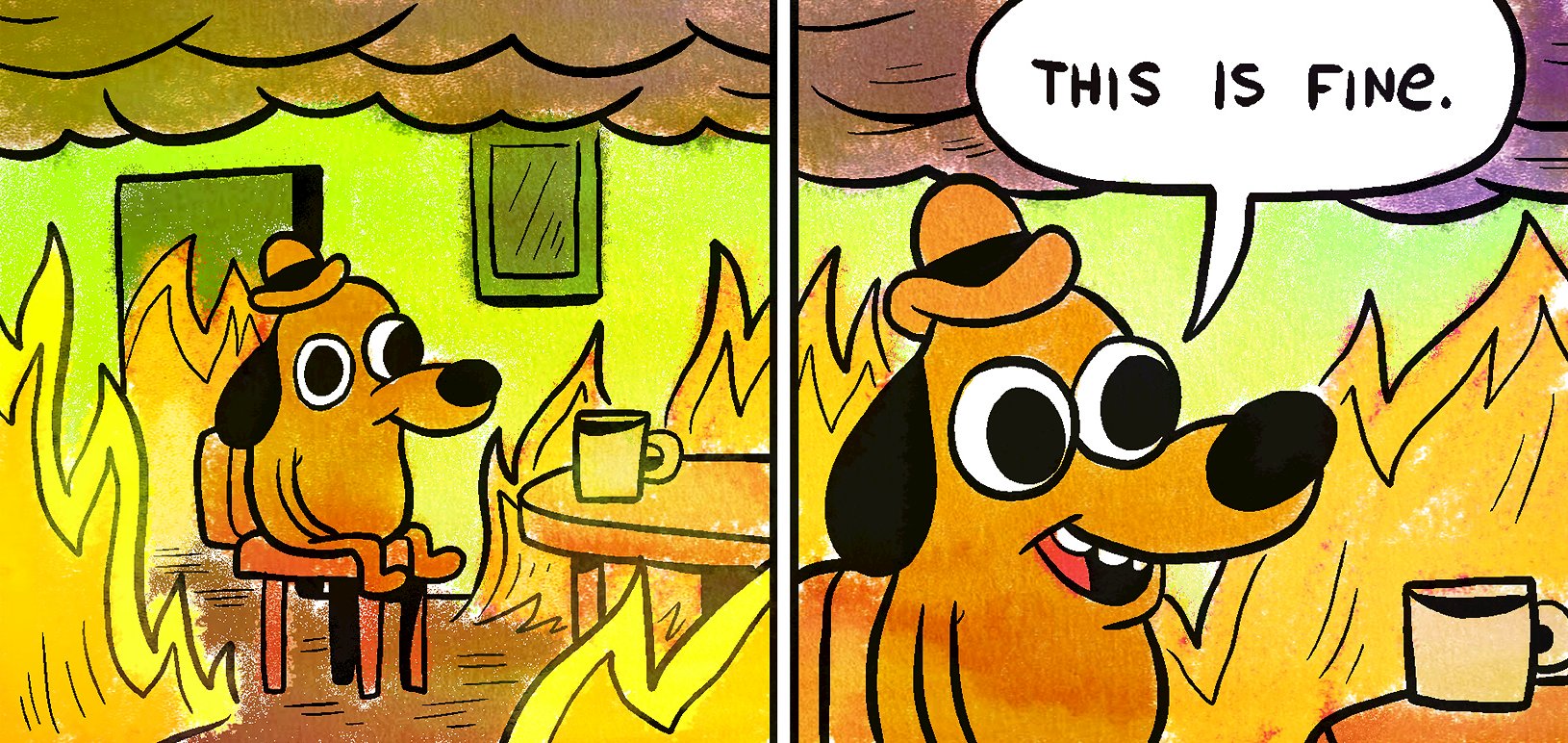
And there’s no guarantee we get through this one. That’s the uncomfortable part. Not every transformation succeeds. The chrysalis phase is genuinely dangerous. We may have made it worse, too — by ignoring warning lights, by letting systems fail while insisting everything was fine. We amplified this. The dominoes are falling. We can’t stop them now. We had the ability to prepare, and we didn’t. Instead the dominant response has been the dog in the burning room. This is fine. Everything’s fine. We’re drinking our coffee while the house burns down.
But — and I need to be clear about this because I know how it sounds — this is not fatalism. This is the opposite. I haven’t given up. That’s why I keep writing this stuff. That’s why I keep pushing. Why I keep building. We need infrastructure for the new paradigm. If I am wrong, worst case I build really cool things. I am right, we are going to need the tools to build the new foundation.
The universe is participatory. We have to show up. Experience is part of it — you have to do the work, practice, engage. If you’re just given the answer, you don’t internalize it. That’s the whole point.
If everyone could accept that the transition is happening, stop fighting it, and start working together — not blindly accepting whatever happens, but actively participating, minimizing damage, helping each other through — it would get easier. Not easy. Easier. That’s not naive. It’s basic systems dynamics. A system that stops wasting energy on resistance has more resources available for adaptation.
The Skill That Actually Matters
The reason most people won’t do this — put the load-bearing premises of their worldview on the table and honestly assess them — is that it hurts. It is dissonant. It triggers survival-level responses. The brain doesn’t distinguish between a threat to your body and a threat to your self-model. The amygdala does not care whether what’s attacking you is a predator or a paradigm.
But here’s what I’ve learned — and this is from personal experience, not a textbook. Accepting that your worldview might be wrong is terrifying right up until you actually do it. And then something strange happens. You stabilize around a new normal, and that normal is stronger than what you had before — because it’s built on the bare essentials, the things that are genuinely unlikely to be destabilized. Everything else you hold provisionally. You learn to live with the uncertainty because you know it could change. This is how new possibilities form. You can’t align with a potential future that is blocked off.
People who live in high-risk areas — hurricane zones, earthquake regions — don’t experience each disaster as existential. They’ve metabolized impermanence. The structure they build their lives around isn’t immunity from disruption. It’s resilience to it. And paradoxically, that’s more stable than what you get from insulating yourself from everything threatening — because it doesn’t depend on the insulation holding.
The skill that makes this livable is metacognition. Practical metacognition — not the philosophy department version. Noticing when your response to an argument is defensive rather than analytical. Recognizing that physiological signature, the tightening, the surge of “no.” And choosing — not in the moment, because that’s too late — but through practice, accumulated practice, to respond with curiosity instead of armor. The prefrontal cortex can modulate amygdala activation when it’s been trained. Therapy does this. Meditation does this. Sustained reflective practice does this. The capacity is real. It’s physical. It can be developed.
That’s what I showed you in the first section. The move — question your assumptions, find the boundary, check if the contradiction is in reality or in your framing — is metacognition applied to ideas. It’s the same skill applied outward instead of inward. And once you start doing it, you find the same thing every time: most of the problems we’re stuck on aren’t problems. They’re artifacts of framing that nobody thought to question. Not because the questions are hard. Because asking them is uncomfortable.
Science as an institution does not have this capacity yet. It doesn’t have the metacognitive ability as a system to step back and observe its own defensive patterns. It can’t model itself. It can’t notice that it’s in survival mode and choose differently. And this is the part that I think most people miss — it’s not enough to have philosophy of science or sociology of knowledge sitting on the side, writing critiques that the institution ignores. You need a reflexive loop. A field that can study science as a system and feed back into the institution in a way that the institution actually integrates. Bidirectional. Not critics on the outside lobbing observations in. An actual feedback mechanism, built into the structure, that the sciences participate in rather than defend against.
We don’t have that. We have philosophers of science who write about paradigm shifts and institutional dynamics, and working scientists who largely don’t read them. Two communities talking past each other about the same thing. The silos I keep writing about — they apply here too. The thing that could help science become self-aware is itself siloed away from science.
This is where I think resonance theory and conceptual studies come in — not as another silo, but as a framework that operates at the level of how information self-organizes across all domains, including the domain of science itself. A meta-theoretical framework that doesn’t replace the others, it connects all of them together. Conceptual studies is the study of the constraints reality places on all forms information can take. That includes the forms science takes. It has to, or it’s incomplete. And crucially, any theory that plays this role must apply to itself — it must be subject to its own analysis, its own destabilization, its own revision. I don’t believe we currently have many theories that meet that bar. Most theories exempt themselves from their own logic. They describe reality but don’t account for how they themselves exist as information systems within that reality. That’s the gap.
I don’t have a neat conclusion for you yet. I distrust neat conclusions anyway. What I have is an observation and an invitation. The observation is that fear — real, physiological, survival-level fear — is running the show in places that believe themselves to be governed by reason. The invitation is to notice it. In yourself first. Then everywhere else. If we all do this together, it really isn’t that scary.
I think that’s where the work starts. I think that’s all I can honestly say right now. The rest I’m still figuring out, and I’d rather tell you that than pretend I’ve got it wrapped up.
The only certainty is uncertainty.
Sources
[1] Measurement problem. Wikipedia; https://en.wikipedia.org/wiki/Measurement_problem
[2] K. Friston, The free-energy principle: a unified brain theory? Nature Reviews Neuroscience 11, 127–138 (2010).
[3] L. Feldman Barrett, How Emotions Are Made: The Secret Life of the Brain (Houghton Mifflin Harcourt, Boston, 2017).
[4] T. Kuhn, The Structure of Scientific Revolutions (University of Chicago Press, Chicago, 1962).
[5] D. Grey, The Architecture of Intellectual Retreat. Daniel Grey (Substack, 2026);
[6] B. Libet, C. A. Gleason, E. W. Wright, D. K. Pearl, Time of conscious intention to act in relation to onset of cerebral activity (readiness-potential). Brain 106, 623–642 (1983).
[7] M. Balaguer, Free Will as an Open Scientific Problem (MIT Press, Cambridge, MA, 2010).
Currently Resonating:
- Refused — “Liberation Frequency” — 1998, The Shape of Punk to Come, Burning Heart/Epitaph. “What frequency will liberation be?” If you’re writing a post about reclaiming the airwaves from institutional noise, this is the only opener. They broke up immediately after recording this because they couldn’t reconcile anarchist principles with rock stardom. Integrity has a cost. Such a great album.
- Mad Caddies — “Coyote” — Ska-punk out of Solvang, California. Horns, upstrokes, and a groove that refuses to take itself seriously while being technically tight. Sometimes the most subversive thing you can do is have fun. This is that. Whenever I listen to this group, I can’t help but smile.
- Mastodon — “Steambreather” — Emperor of Sand, 2017, Reprise. Slow, heavy, inevitable (and catchy). Mastodon has always understood that heaviness is not volume. It’s weight. There’s a difference.
- Beck — “The New Pollution” — Odelay, 1996, DGC. Beck made an entire career out of refusing to be one thing. This track is bossa nova filtered through lo-fi production and ironic detachment — except it’s not ironic at all, it’s gorgeous. Genre is a suggestion he politely declined.
- Blue Man Group — “Drumbone” — Percussion as language. No lyrics, no melody in the traditional sense — just rhythm, texture, and PVC pipe. Proof that communication doesn’t require words. The information is in the structure. I’ve been saying that for a while now. This is still one of the coolest performances I saw in High School.
- The Dillinger Escape Plan — “When Acting As A Particle” — Ire Works, 2007, Relapse. Yes, the title. In a post about the measurement problem. I’m not subtle. But neither were they — controlled chaos, mathcore precision, time signatures that feel like they’re arguing with themselves. When acting as a particle, you behave differently than when no one’s looking. Sound familiar?
- Herbie Hancock — “Chameleon” — Head Hunters, 1973, Columbia. Fifteen minutes of groove that changed what jazz could be. Hancock walked away from pure bebop and into funk, and the jazz establishment lost its mind. He didn’t fight them. He just played something better. Paradigm shift as a bass line.
- Imminence — “Heaven Shall Burn” — Violincore that hits like a wall and doesn’t apologize. The name says it — imminence. Something is coming. You feel it before you hear it. That’s the chrysalis talking.
- Oxymorrons — “Justice” — Queens, NY. Hip-hop, punk, rock, metal — they don’t blend genres, they ignore the premise that genres are separate. POC band in rock spaces reclaiming territory that was always theirs. All proceeds go to community organizations. Music as infrastructure. That’s the move. Saw them last year, terrific group.
- TesseracT — “Natural Disaster” — UK progressive metal / djent. Polyrhythmic, atmospheric, precise. They build tension the way pressure systems build — slow, patient, and then everything shifts. The title writes itself for this post. Natural disasters aren’t punishment. They’re what happens when systems can’t hold anymore.
Related Pages
No other pages link to this page.