We Forgot How to Leave
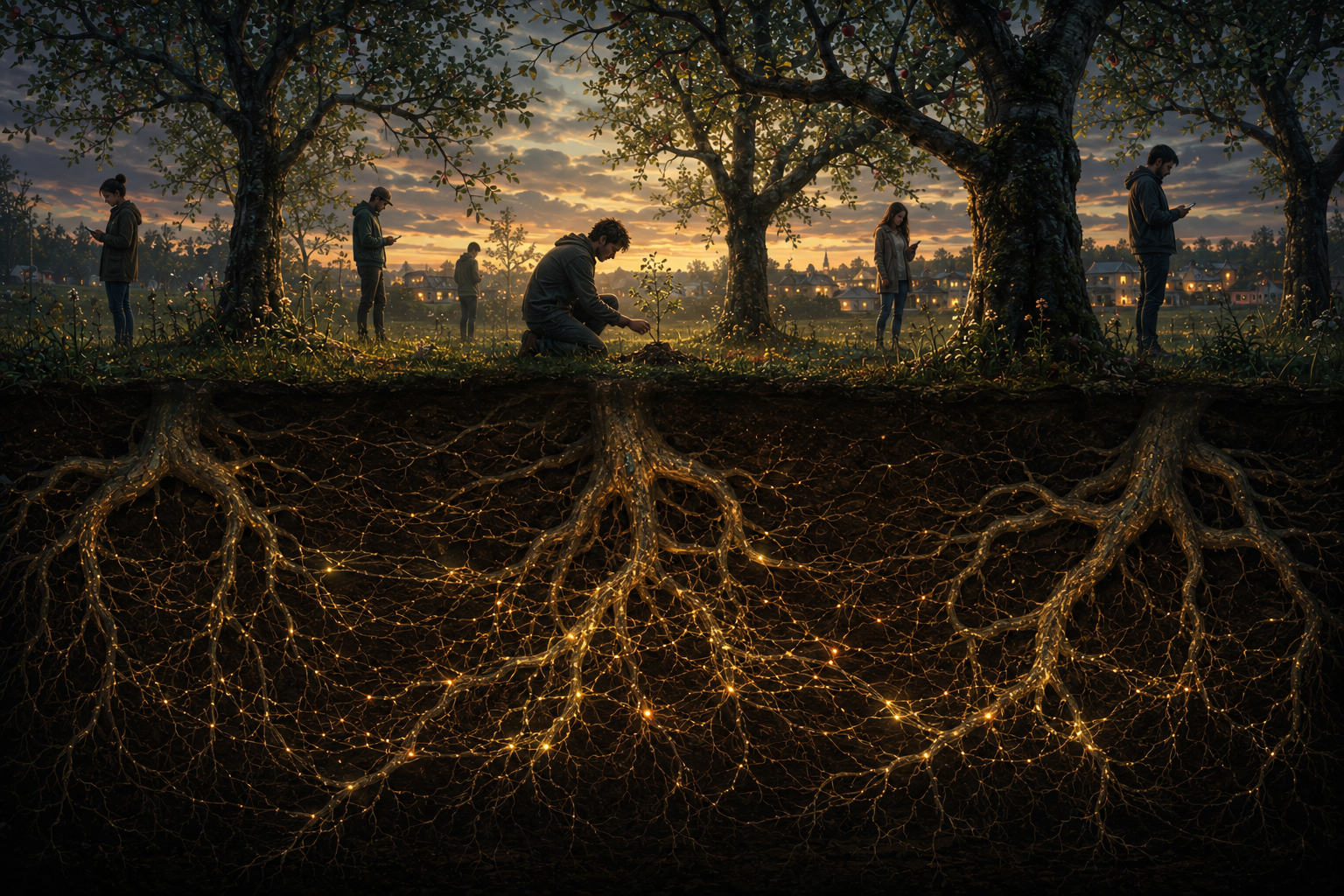 "“We’ve got a choice but still we’d rather choose to suffer”— Architects, Impermanence"
I was outside with my dog this morning when I noticed a nest of caterpillars in one of my apple trees. I have an orchard — and before you picture rows of perfect trees stretching to the horizon, let me be clear. I bought an old orchard property a few years ago (it was built in the 1850’s). I’ve got six trees. I’m learning as I go. It’s a hobby. It’s a long game. I have come to appreciate the long game. Trees take years to acclimate before they produce anything, and most of what I’m doing right now is just tending and watching and figuring out what I don’t know yet.
But the caterpillars. They’re invasive — probably gypsy moth, I need to ask my cousin, he’s the bug expert. A few years ago in New York, they came through and killed a lot of good trees. And I stood there this morning with this tiny ethical moment: I don’t like killing things. I prefer to let nature take its course, but with invasive species, that is not always a good thing. For my orchard, and the local habitat, it is not. I believe in balance. The tree is better for the ecosystem than the caterpillars are. It’s not about the tree versus the caterpillars. It’s about the system. Future trees. The soil. The birds that nest in those branches. The whole web of relationships that one tree supports. Not to mention the trees the caterpillars that are growing now will eat. The cycle will continue. Sometimes protecting the system means making a hard call. The challenge now, is how to do so surgically, with the least damage. I like challenges. I will let you know how that turns out when I figure it out.
Anyway, that’s not domination. That’s stewardship. So I thought — that’s the whole thing, isn’t it? That’s everything I’ve been writing and talking about. That’s this post.
So here it is.
Share
The Happening (not the terrible movie)
I wasn’t planning on writing this post until just now. And that’s because I don’t plan any of my posts. That’s on purpose. They just sort of happen.
I’m a perfectionist. I always have been. I’m also a creative. That’s the worst combination I know. I’ve talked to a lot of friends about this — most of my friends are creatives, and they understand it perfectly. We work on pieces. I was a composer. I would release a song. Writers do this. Artists, everyone. When is a piece done?
It’s never done.
The most likely answer from an honest artist is: when somebody wants it. Or the deadline hits. Or both. Because if they have the say? It’s incredibly rare for them to sit back and go — that’s perfect. That’s exactly what I wanted. There’s always something you’d tweak. Always something you didn’t quite get right. Even if it’s super minor and overall you’re like, it’s as good as I’m gonna get it and I have to move on — that doesn’t mean it’s done. It means you’ve accepted the gap between the thing you see in your head and the thing that exists on the page. That gap never closes. You just learn to live with it.
So for me, if something makes it into a draft, it’s dead. If I don’t finish it in a certain window, it’s not getting published. Because once I start poking at it, I can’t stop poking at it, and then I’m just rearranging deck chairs forever. Proof of concept — I’ve about 17 drafts started and they most likely won’t see the light of day. At least not in those forms. I can’t get them where I want them yet. So instead, I’m writing this one.
If you’re reading this, that means I got through the next hour or two. If you never see this, well — you know why. Think about that one for a minute.
This wasn’t a rule before. But I think it’s going to be one. If I don’t get it out in one go, it dies. And here’s the thing — if I had planned out all the pieces I’ve already published, I wouldn’t have published anything yet. Not a single one. Every post you’ve read from me exists because I didn’t give myself time to kill it.
I improv better. It’s how I bypass the part of my brain that won’t let go. And it lets me turn around and say — well, it’s not perfect, because that’s what it is. That, I think, is what allows me to actually do this. It’s also why I have unpublished papers. Not because they’re bad. I’ve had several people read Res2Vec and the other stuff I’ve been sitting on, and their reaction is always the same: why haven’t you published this? And I’m sitting there going — it’s not done yet. And they’re looking at me like I’ve lost it. But that’s how this works.
So if this post feels raw, that’s because it is. That’s the deal.
Survival of the Fittest Lies
Here’s where I was this morning before I decided to write.
I was thinking about survival of the fittest.
Not the biology. The mythology. The story we’ve built around it that has almost nothing to do with what actually happens in nature.
I brought this up to a friend recently. I said — we’re the only ones that do this to ourselves. Normalizing competition, normalizing that reality is harsh (it can be, if you are alone) and those who can’t survive will suffer as they lack whatever is necessary to survive. We seem to be the only species who chooses to suffer as a lifestyle.
They pushed back: other animals suffer too. And sure, yes, they do. I’m not saying suffering doesn’t exist in nature. That is kind of silly if you think about it. What I’m saying is it’s not the primary mode of existence for anything except us. We’re the only species that has taken suffering and competition and turned it into a philosophical framework for how society should work. What we observe in another species is that the norm, while it might be a struggle, it is not suffering. Suffering causes trauma, it really seems backwards to me that some have normalized this idea that nature prefers to throw harsh things at organisms to force them to adapt through trauma.1
A wolf doesn’t wake up thinking “I must dominate or die.” It hunts when hungry. It rests when it can. It survives when it needs to. It isn’t ‘suffering’.2 But we took “survival of the fittest” and built entire economic systems, social hierarchies, and cultural identities around it. As if it’s a natural law. As if the universe designed us to grind.
It didn’t. At least not the way we have been applying it. Somewhere we ‘decided’ what fitness was, and that same measure we ‘decided’ on seems to keep popping up everywhere (for centuries now).
Here’s what people seem to get wrong about fitness. Fitness is not a fixed attribute. It’s contextual. It depends entirely on the environment you’re in.
I go into an office. Office meeting. Technically, it’s survival of the fittest — whoever navigates the situation best comes out ahead. But fitness in that environment might mean diplomacy. Collaboration. Listening. If you walk in and try to dominate, you’re not the fittest — you’re the weakest thing in the room. You’ll get fired. That’s not surviving. In that context, domination is the least fit strategy available.
But we’ve collapsed “fittest” into one meaning — strongest, most aggressive, most competitive — and then structured everything around that single, wrong interpretation. That’s not science. That’s a cultural narrative wearing a lab coat.
Let me be clear about what I’m saying here. I’m not saying survival of the fittest doesn’t exist. It does. I never said it doesn’t. I’m saying we imported a descriptive phrase from biology into our moral and economic systems and then pretended it was natural law. We took something that describes what persists and turned it into a prescription for how we should behave. That’s a category error. And it’s the category error that’s killing us. We created a standard of fitness that does not match reality.
Do Humans Migrate?
In the real natural world, if you’re in a location where you’re struggling, where you’re suffering, and you can leave — you do. That’s what migration is. That’s the whole point. Birds don’t debate whether they should tough it out through winter. They don’t hold committee meetings about it. They just go somewhere where survival is easier and suffering is unnecessary.3
But we’ve built systems where leaving isn’t an option. Borders. Economics. Cultural pressure to stay and compete and suffer through it. We’ve removed the escape valve that every other animal has. We’ve essentially done to ourselves what we do to caged animals — except we’ve convinced ourselves it’s noble. We call it grit. We call it resilience. We call it work ethic. But it’s a trap. A trap we designed, built, and then forgot we could dismantle.
When animals are stuck — truly stuck — it’s usually because of a natural disaster, or because of us. Humans are the primary reason animals get trapped in environments they can’t leave. That’s not the norm in nature. The norm is freedom to move, to find better conditions, to adapt by choosing differently. We took that option off the table for ourselves and then wondered why everyone is miserable.
So why am I here?
On Substack, I mean. Not existentially — that one’s a longer post. Maybe that will happen someday. Time will tell!
I’ve complained before about people not engaging with my work. But I want to be precise about what I actually mean. It’s not the work itself I need engagement with. It’s the conversation. I couldn’t care less if people read my pieces — if they were talking to me, if we were engaging. That’s the main reason I’m here. Not to broadcast. Not to build a newsletter empire. To talk. To meet people. To have actual discussions where ideas get tested and pushed and broken and rebuilt. I am playing the long game, hoping my interactions and pieces find those when they need them, and give them something to think about. You know I think that is called human interaction, at least the way we used to do it?
Nobody else seems to want to do this. And I think it’s a byproduct of culture and social media. We’ve gotten used to focusing on our little realms — our content, our output, our brand. I’ve written about this before: we’re shifting from the output phase to the process phase. The new scarcity isn’t what you produce. It’s how you produce it. We’re heading toward an artisan economy — and I don’t mean that metaphorically. I mean the market forces are going to push us there whether we want it or not (most likely).
Think about it. AI, 3D printers, the entire confluence of technologies that have been building since the 2000s — all of it has lowered the barrier to entry for production to essentially zero. Anyone can manufacture. Anyone can publish. Anyone can generate content at scale. Which means production itself has no scarcity value anymore. Supply has outpaced demand by such a margin that the floor has dropped out.
Not everyone can afford a 3D printer or a home studio yet. I know. But not everyone could afford a computer in the nineties either, and that still transformed everything. These tools are in the realm of regular home ownership now. That’s the threshold that matters — not universal adoption, but plausible accessibility. The trajectory is what changes the game, not the current snapshot.
This is where I go back to the music industry as a baseline. In the 2000’s, in another life, I was trying to break into the industry as a performer and sound engineer. Studio time was expensive. Getting a quality sounding recording of your band was incredibly difficult if you did not have thousands of dollars. Now? Most computers have the hardware necessary and we have plugins (some AI driven now) to make you sound like you recorded at Abbey Road. What differentiates you now is not production quality, it is if you actually recorded at Abbey Road (looking at you Architects)
So What’s Scarce?
Care. Rigor. Craftsmanship. Things built to last. Things made with intention by someone who gives a damn. The artisans — the people who put thought and effort into what they make — are going to differentiate themselves from the mindless output that’s just manufactured noise. And we already see the platforms for it. Substack. Etsy. Self-publishing on Amazon. Independent musicians recording in their bedrooms and reaching audiences in Japan that a record label couldn’t have connected them to in the nineties. The gatekeepers are gone. The barriers are gone. And what rises to the top in a world without barriers?
The things that can’t be replicated at scale. Quality. History. Meaning.
I saw someone selling hand-bound editions of public domain books on Amazon. Forty dollars. You’re not paying for the content — it’s public domain, it’s free. You’re paying for the binding. The craftsmanship. The fact that someone spent time making something beautiful and durable. That’s the new economy. That’s what people actually want when the mass-produced version is disposable and everywhere. A 3D-printed Pop Funko is not an authentic Pop Funko. Rarity. Story. Intention. Authenticity. These things have value that scales inversely with how easy everything else becomes.
The Smoke Monster
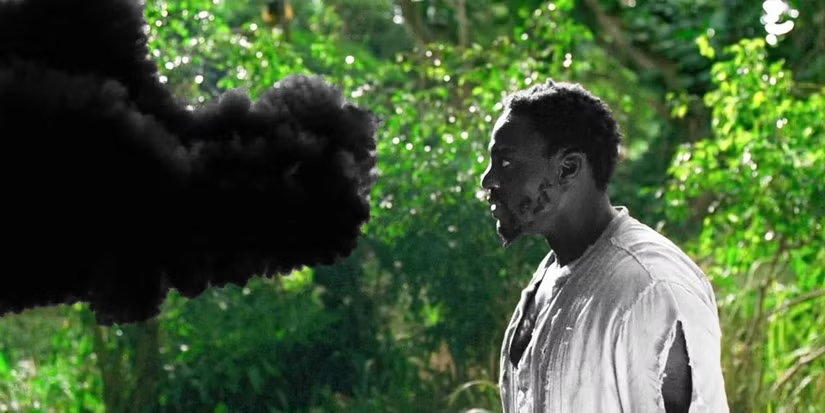
But here’s the thing about the digital space. Quality alone isn’t going to be the differentiator online. Not in the same way.
Content has become a consumption product. It’s not a chair you sit on for twenty years. It’s not an operating system you install. A blog post, an article, a song — most people consume it once and move on. That’s not a criticism, it’s just the nature of it. So quality in the traditional sense — durability, reliability, polish — doesn’t map the same way.
What does map is the shared connection.
You know what I miss? Water cooler talk. Who is the smoke monster? How are they going to get home? What is the island? Is it purgatory?5
Remember when everyone had to watch the same show at the same time? Not because streaming didn’t exist — though it didn’t — but because that’s how television worked.6 Seven o’clock on a Friday night, and your whole neighborhood was watching the same thing. Not together. But together. And the show itself wasn’t the point (there was not as much choice back then). The show was the entry ticket. The real thing — the thing I actually remember from my childhood — was the next day. Quoting Futurama to your friends. Talking about what happened on Lost. Riffing on The Simpsons at lunch. Bonding over shared experience.7
I don’t remember watching those shows as much as I remember talking about them with others. I remember the connections that formed around them. The show was the excuse. The relationship was the product. If we project backwards in time with media, we can see this pattern everywhere. Everyone loves a good story. But we love experiencing it together. Don’t believe me? Religions, governments, ideologies are all centered on stories, on narrative. A thread that we can all share and talk about. Something that connects us.
And I know I’m not the first to say this. People have been saying it since the dawn of social media. But here’s what I think most of them miss: it’s not just that we’re isolated. It’s that we’ve normalized surface-level connection as actual connection. We sit in the same room on our phones and call it hanging out. We follow each other on platforms and call it friendship. We are more “connected” than any generation in history and lonelier than any of them were.
What’s bizarre is — I actually watch TV shows now and the characters interact in ways that I remember people interacting in real life. Talking to each other. Hanging out face to face. Not glued to screens. Sure, phones pop up when we need a plot device, but the writers know that no one wants to watch people just stare at their phones the whole time. So people watch it and think — that’s fiction. It does not feel like normal conversation.8 That’s a TV show. And I sit there thinking — no, that used to be normal. The fictional part was the ridiculous sitcom plot where someone blows up a car as a practical joke and gets forgiven in twenty-two minutes. The talking to each other part? That was real. That was Tuesday. Or at least it should have been.
If we filmed a realistic TV show today, everyone would be on their phones and no one would watch. The ratings would be terrible. They would be terrible, terrible numbers. The worst ever. The most terrible ratings you have ever seen.
Its Strategy
This connects to what I was writing about in the Architecture of Intellectual Retreat series. Those pieces were framed as intellectual case studies, because they were about intellectual topics on an intellectual platform. But the pattern isn’t limited to intellectuals. This is just how people act when they encounter something they don’t like. They retreat. They disengage. They block. They pretend the conversation never happened.
I want to state something clearly, because I think it matters: I don’t believe any of the people I wrote about are bad people. Not one of them. Not even close. They think what they’re doing is what everybody does — and they’re right. It is. They’re trying their hardest. They’re doing their best. They’re not perfect. But our society, partly because of the survival-of-the-fittest mentality, expects perfection. It expects something that cannot be reached. And so the emotional machinery kicks in — protect yourself, don’t be seen making mistakes, don’t be seen being wrong, don’t be seen correcting yourself because in this culture, if you said something wrong, you had to have known it was wrong when you said it.
That’s absurd. But that’s where we are. We taught ourselves this is how it is to where we have internalized it, normalized it, and believe it without reservation and we then wonder why we are suffering. We are not meant to do this. We drew the boundary in the wrong place again. That is what the move is for.9
And this is why I’m here doing what I’m doing the way I’m doing it. I’m not here to build a newsletter. This is here for my thoughts and for me to make connections and to try to demonstrate — in real time, with my actual self, mistakes and all — that when people engage, things can change.
The tragedy of the three blocks I’ve written about is simple: if any of them had engaged differently, none of those pieces would exist. If they had pushed back on me in the comments instead of blocking me, we would have had a conversation. I would have heard them out. I always assume the other person knows something I don’t. Always. That’s not performative humility — it’s just how I operate. I know I don’t have all the information. Nobody does. Socrates figured this out thousands of years ago. The ones who have engaged with me — like — have realized that, yes, I’m direct, but the abrasiveness isn’t entirely mine. It’s the fact that people aren’t used to directness anymore. We’ve atrophied the muscle for handling disagreement. It’s like never exercising and then being asked to do a hundred fifty push-ups. Of course it hurts. But that’s not the push-ups’ fault.
Survival of the fittest isn’t about dominating your environment. It’s about learning, growing, adapting, and evolving so you can thrive in it. The fittest is the one that can best adapt to any environment. Adaptation requires discomfort. Growth requires friction. And we’ve built a culture that treats both of those things as threats rather than tools.
And this brings me to something I touched on in my last post that I want to name more directly: privilege. Not racial privilege specifically, though that’s part of it. Not economic privilege specifically, though that’s part of it too. I’m talking about something older and more fundamental. Call it individualist privilege. The belief that you can act without consequence. That others must accommodate your mistakes, your discomfort, your fragility — because challenging you would be impolite, or unfair, or too much. I believe this is the primary issue facing Americans right now. We aren’t the only ones facing this issue, but we seem to be the loudest.
This is the privilege that people are losing right now, and it’s why they’re furious.
You know what people call cancel culture? I think, in aggregate, it’s the leveling mechanisms coming back online. This is Boehm’s Reverse Dominance Hierarchy — the ridicule, the shunning, the ostracism that kept potential dominators in check exerting itself under pressure. We never lost those instincts. We just suppressed them for a while because certain people had enough power and insulation to avoid the consequences. Now, with information flowing everywhere and social accountability expanding, that insulation is eroding. And the people who never had to face consequences before are experiencing them for the first time and calling it tyranny.
I’m not saying cancel culture is pure justice. It’s not. It overcorrects. It sometimes targets the wrong people. And those excesses feed the backlash, which is how system dynamics work — pendulums swing hard both ways. But the existence of overcorrection doesn’t negate that something real shifted. Social accountability is reasserting itself.
People who broke the social contract used to get away with it. Increasingly, they don’t. And the ones who are angriest about it are the ones who assumed they were immune. I am calling this ‘trickle down accountability’. In the past those in power had to spend more energy in controlling the narrative. Now everyone has to. Privacy is evaporating and the narratives we tell ourselves can be directly challenged with evidence that anyone can access.
By the way, I speak in aggregates, not binaries. There is no singular cause, no singular factor. It’s not the only factor, but I think it’s one of the biggest ones. And the people fighting hardest against it are the ones with the most to lose — which is to say, the most unearned advantage to give up. Privilege is gravy. It’s extra. It’s the thing you probably shouldn’t have had in the first place because it was making the game unequal. Losing it feels like loss because you got used to it. But discomfort isn’t injustice. It’s just the field leveling out.
The Customer Is Always Right
I worked in a local grocery store growing up. Not a big chain — a franchise, small, five aisles, full deli and meat room, maybe seventy employees with the ice cream shop included. We competed against five other big chains in our city, and we weren’t in a big town. We just had a lot of grocery stores. And we won — consistently — through customer service.
The customers knew who was cutting their meat. They knew the stock boys by name. They knew me. I knew them. They’d come in and tell us about their kids hockey game while I was working produce. They’d bring us stuff.10 They’d refuse to go to the bigger stores because it was impersonal. They paid more to shop with us. Not for the products — the products were the same. They paid for the relationship. For being seen. For belonging to something that felt like a community.
That’s value. Real value. The kind you can’t manufacture. The kind that doesn’t show up on a quarterly earnings report but keeps people coming back for decades. It’s the long game.
I saw the same thing at Staples later in life. I worked tech support there for about two years. Corporate wanted us to sell, sell, sell. Compete with the Manhattan stores. Which was absurd — we were a small-area store, the only one for miles. People from other counties drove to us. And in our area, five bucks was a big deal. People were counting pennies.
So when someone came in looking for a computer and I didn’t have one that met their needs, I told them where to go. My general manager was horrified. Why didn’t you try to sell them the one we had? And I said — because they’d bring it home, find out it doesn’t work for them, feel ripped off, and return it. We’d cost ourselves the sale anyway, and we’d lose the relationship permanently. Every single time. I also would have slept worse at night.
I had regulars within two months. Why? Because trust is the actual product. Everything else is just the delivery mechanism. They would literally leave if I wasn’t on shift and come back when I was. That was a different problem though, a good one to have I guess, as we were all a team and didn’t work on commission.
People will pay more for things they trust. People will drive further for people who don’t screw them over. This isn’t business theory — this is business 101 that somehow everyone has forgotten (I think) due to convenience. Customer loyalty, psychologically, is more important than what you’re selling, how you sell it, or what sales you’re running. There will always be people who chase the cheapest option. But most people? They want to feel good about where they spend their money. They want to feel seen. They want to not have to think about it — and that’s the key.
Making decisions is expensive. Literally. It burns calories. It takes processing power. That’s why we build heuristics, unconsciously I might add — mental shortcuts that save us from having to evaluate every single choice from scratch. Brand loyalty isn’t irrational. It’s efficient. You found something that works, so you stop spending energy evaluating alternatives. That’s not stupidity (assuming you can trust the brand). That’s optimization.
And that — right there — is what survival of the fittest actually is.
It’s not domination. It’s not competition. It’s optimization of information processing. Our brains take shortcuts. Our bodies conserve energy. Organisms optimize for their specific context. That is what drives evolution and behavior. Not some brutal meritocracy where the strongest wins and the rest suffer. We’ve been using the wrong metaphor this entire time, and we’ve built society around the wrong assumptions, and we’re wondering why everyone is exhausted.
Reframing Society
Things seem to make a lot more sense through this lense.
People are constantly fatigued, burnt out, running on fumes. Mental health issues are through the roof. Depression, anxiety, fear — all at levels we haven’t seen before. People are leaving unfulfilling careers to find something meaningful. They’re realizing the value isn’t money. It isn’t just getting by. It’s what matters to them. People pay money for antiques not just because they last — because they have stories. History. Somebody made this, and it traveled through time, and there’s a whole life behind it that you get to hold in your hands.
People love stories. That’s what the water cooler was about. That’s what the grocery store was about. That’s what engagement is about. Not metrics. Not output. Stories. Connection. Being part of something that knows your name.
We are social beings. The studies are overwhelming. We used to be tribes — not the dominance hierarchies we inherited from our primate ancestors, but something that actively inverted them. Anthropologist Christopher Boehm called it a Reverse Dominance Hierarchy: instead of alphas dominating groups, groups collectively dominated potential alphas. Ridicule, gossip, shunning, ostracism, exile — these were the leveling mechanisms. The many keeping the few in check. Not the few controlling the many. That was the configuration for most of human history. Roles existed. Prestige existed. But rigid, institutionalized inequality? The group wouldn’t tolerate it.
And then it flipped back. Agriculture. Surplus. Sedentism. Population growth. Groups got too large for the leveling mechanisms to hold, and the phase snapped back toward top-down hierarchy — but now at a scale our ancestors never imagined. People stopped leaving, we owned land, we had to protect it. That’s the double inversion. Original primate dominance, then Paleolithic reversal, then Neolithic re-inversion at industrial scale. And now we look at the current arrangement — the second flip — and call it “human nature.” As if we didn’t spend the vast majority of our existence doing the opposite. As if the baseline was the anomaly and the breakdown was the truth.
It wasn’t. The thing we call natural is the thing we tipped into under specific conditions. It’s not destiny. It’s a configuration. And configurations can change.
That’s the paradigm we’re shifting back to. Not because it’s trendy. Because we have to. The survival-of-the-fittest framework is literally breaking people. You’re told you’re not supposed to be happy. You’re not supposed to have meaningful connections. Just optimize. Just compete. Just produce. And then what? You’re depressed. And you look around and see other people who rejected all of that and they’re actually happy. And that’s when it clicks.
We don’t have to live this way. We never did.
An Update
I have apologized to Dr. Sam. I have not heard back. I doubt I will. I don’t blame him. I hope, if he reads this, that he reaches out — because I’d genuinely like to have a conversation. An actual one. About the work, about the ideas, about where we agree and where we don’t. I stand by my analysis of his public work and behavior because I took the time to make sure it was clean. But the email I sent — the raw, emotional reaction — that’s the part I’m not proud of. My words undermined my intent. That’s mine to own. It is up to me to do better the next time I am confronted with the same situation. That also includes how I engage in the shared space. While I hope for others to work with me, I am always calibrating to work with others. Sometimes I miss. I am getting better though.
With my CPTSD— I’m in remission, which means maintenance mode — I catch myself, I course-correct, I do the work every day. Sometimes I don’t catch it in time. The Dr. Sam situation was one of those times. Maybe next time I will. That’s the point. Just keep working on it. Each time it gets a little easier. Each time the gap between the trigger and the awareness shrinks a little more.
I put my struggles on the page publicly because I am a staunch advocate for mental health awareness and I believe the stigma around CPTSD and trauma is one of the most damaging forces in people’s lives — and the most insidious symptom of the disorder I have found to be is self-stigma. The shame. The voice that tells you you’re broken and nobody else could possibly understand. When I was healing, I felt completely alone. And when I found other people who had been through similar things — even if I never met them, even if I only read their words — it made me feel less alone. That mattered more than any technique or therapy or book. The voice never goes away by the way, it has just gotten a lot easier to ignore.
So I model it. Publicly. Imperfectly. Because that’s the only honest way to say — if you’re going through this, you’re not alone, and it’s not a straight line, and you will fail the test sometimes, and that’s part of the process. Not a sign that it isn’t working. You can always learn something of use for next time, especially if what you learned is that it wasn’t as bad as the last time. That’s progress. Make amends (if you need to) and move forward.
We cannot control what we do in the moment. That’s neurologically established. What we can control is what we do after — the reflection, the analysis, the choosing differently next time, addressing our behaviors. That’s metacognition. That’s where free will actually lives. Not in the moment of reaction, but in the practice of learning from it. And that practice requires exposure. You can’t just meditate on it. You have to be in situations that test you, and sometimes you fail the test, and then you analyze the failure, and then you’re better prepared for the next one.
This is not survival of the fittest. This is something much more interesting.
Ecosystems don’t want domination. They want balance. Survival of the fittest — the version we’ve mythologized — is what happens when an invasive species upsets the balance and destroys everything. That’s not success. That’s collapse. It is chaos without structure.
The Hard Truth To Swallow
And in one narrow, unflattering sense, I believe we are special. Not in the cosmic, crown-of-creation sense — I reject that entirely. Every species is unique. We’re not the center of reality though. We’re one intelligence of many. But we are, as far as I can tell, the only species that designs elaborate systems that make us miserable and then justifies them as “natural” or “inevitable.” We are uniquely capable of self-harm at planetary scale while insisting we’re being realistic. That’s our special thing. It’s not a compliment. The rest of reality just keeps doing what works. We cling to what hurts and call it wisdom. And reality doesn’t care about our story — it just hands us the bill. We are the best at hurting ourselves.
The alternative is right there. It always has been. Learn. Grow. Adapt. Evolve. And do it together — because that’s how every successful ecosystem in the history of this planet has actually worked. Not through domination. Through relationship. Through mutual adaptation. Through the willingness to be uncomfortable enough to stay in the conversation.
I’m not only writing for the people reading this tomorrow. I never have been. My work is for whoever finds it when they’re ready to hear it — next week, next year, five years from now. I’m not chasing metrics or optimizing for engagement. I’m planting seeds. Some of them won’t make it. Some of them will take years before they produce anything. But the ones that do will bear fruit long after I’ve stopped tending them.
I’ve got six apple trees on an old orchard, and I don’t have everything figured out. I never said I did. But I’m learning as I go, and I’m doing it in the open, and I’m not pretending the caterpillars aren’t there. After I figure that out, I want to plant more trees.
The door is open. It’s always been open.
Come learn and grow with me. I promise I am not the smoke monster…
Sources:
- Boehm, Christopher. Hierarchy in the Forest: The Evolution of Egalitarian Behavior. Harvard University Press, 1999.
- Gavrilets, S., Anderson, D.G., & Turchin, P. “Cycling in the Complexity of Early Societies.” arXiv, 1608.03637, 2016. https://arxiv.org/abs/1608.03637
- Overton, Joseph P. “Shaping Public Policy.” Mackinac Center for Public Policy, c. 1990s. (Origin of the Overton Window concept.)
Currently Resonating:
- EDGE OF FOREVER — As Everything Unfolds (DID YOU ASK TO BE SET FREE?)
- Planning a Prison Break — The Receiving End of Sirens (Between The Heart and the Synapse)
- Father/Son — Wovenwar (Wovenwar)
- Since I Lost You — Issues (Single)
- Altered Eyes — Brand of Sacrifice (Lifeblood)
- Asleep in the Chapel — Thursday (War All the Time)
- You Should Be Dancing — The DGs (Hail Satin)
- See You in Hell — Ad Infinitum (Chapter I: Monarchy)
- Masterpiece — Bayside (Sirens and Condolences)
- Pagan, Pt. 2 — Vitalism (SY)
Of course trauma can force adaptation and evolution, that is literally one of the mechanisms, but it comes with a higher risk. Adaptation and evolution seem to work best gradually, traumatic adaptation usually comes with trade offs and is not the norm.
Surviving does not always mean suffering. Some people love surviving and thrive on survival conditions. This does not mean everyone does. That is the point. It is not one thing. Suffering is context dependent, as is fittest is.
It makes perfect sense to us that animals go where it is easier to survive. Easier to survive means you are (hopefully) not suffering. Perhaps it is actually nice there. If suffering were the norm, animals would be constantly stressed. We know, we have run horrible tests on animals to demonstrate this in our medical and scientific history. We shouldn’t need to do any more right?
I wasn’t sure which video to add, they have two, and they are both excellent. The lyrics to both songs also support the theme I am going for here, but Impermanence does especially. Also, the whole album that song is from is amazing. Let’s take Industrial Metal and put an orchestra behind it and record it at Abbey Road. That is an event, and it is better than the highly produced album.
I am going to clear this up before we have a geek turf war. They were not in purgatory the whole time. The only time they were was the ‘flash-sideways’ scenes in the last season. Everything else happened. This has been clarified over and over again by the creators and I still see so many articles titled: ‘They said it wasn’t purgatory, but it was all along!’. Nope. Not true. That is called a fact, and I will fight you on it.
It was an event! Do you remember where you were when Mr. Burns was shot? Remember talking all summer in-between seasons speculating who did it? Everyone knew it was Smithers (that would have made more sense) until it was revealed that little Maggie did it.
The last time we had a big cultural moment like this that I can remember it was the Avengers: Endgame. Have we had others since? I remember talking about it at the time, we all compared it to when Star Wars first came out (that one is before my time, I am not that old).
I believe this is an example of the overton window effect, usually applied in politics, can shed light here as it seems to describe how we normalize behaviors in a society. Due to the effect, we can see that we accidently might have normalized behavior that we actually used to have. It allows us a potential window into what we have lost.
Please see my previous piece on this topic: The Architecture of Scientific Stagnation
I literally had an older woman bring me corn salsa chowder from Canada because she believed it was the best and thought I would love it. Sadly, I did not. But I appreciated the thought and thanked her profusely for thinking of me and bringing it all the way back, and surviving the tumultuous journey, or at least that is what I remember of the harrowing adventure she had getting it to me. But that is the thing- I wont forget her now. Never, because that memory is meaningful to me. It wasn’t the food product, it was the thought, the story, the narrative. That someone was thinking of me and expended energy on me when I wasn’t there. That is real meaning to me.
Related Pages
No other pages link to this page.