The Struggle of Ambiguity
 "“The art of discovery is therefore the art of correct generalization.” ―Hans Reichenbach, The Rise of Scientific Philosophy"
I’ve spoken a lot about uncertainty and the incredible beauty it brings to reality thus far. But let’s be honest: we can’t live in a world of complete and utter uncertainty all the time. There has to be something to hold on to. I’m not saying objectivity doesn’t exist—it does. It’s just not what we thought it was.
The world hasn’t changed; only our understanding has. Everything we know is still there—it’s just reframed. Yet humans often act as if the moment our understanding shifts, reality itself has shifted. We confuse the change in our perception with a change in the world. But if we discover that something we thought was solid isn’t solid, the truth is it was never solid to begin with. It didn’t suddenly become unsolid; we simply misjudged it.
This need to pin things down, to master and control reality, feels like a form of hubris. It’s a kind of anthropocentric bias—the belief that we, as humans, are the only beings of consequence in the universe. This isn’t an objective fact I’m presenting—it’s an opinion, yes, but one informed by decades of observing, thinking, and questioning.
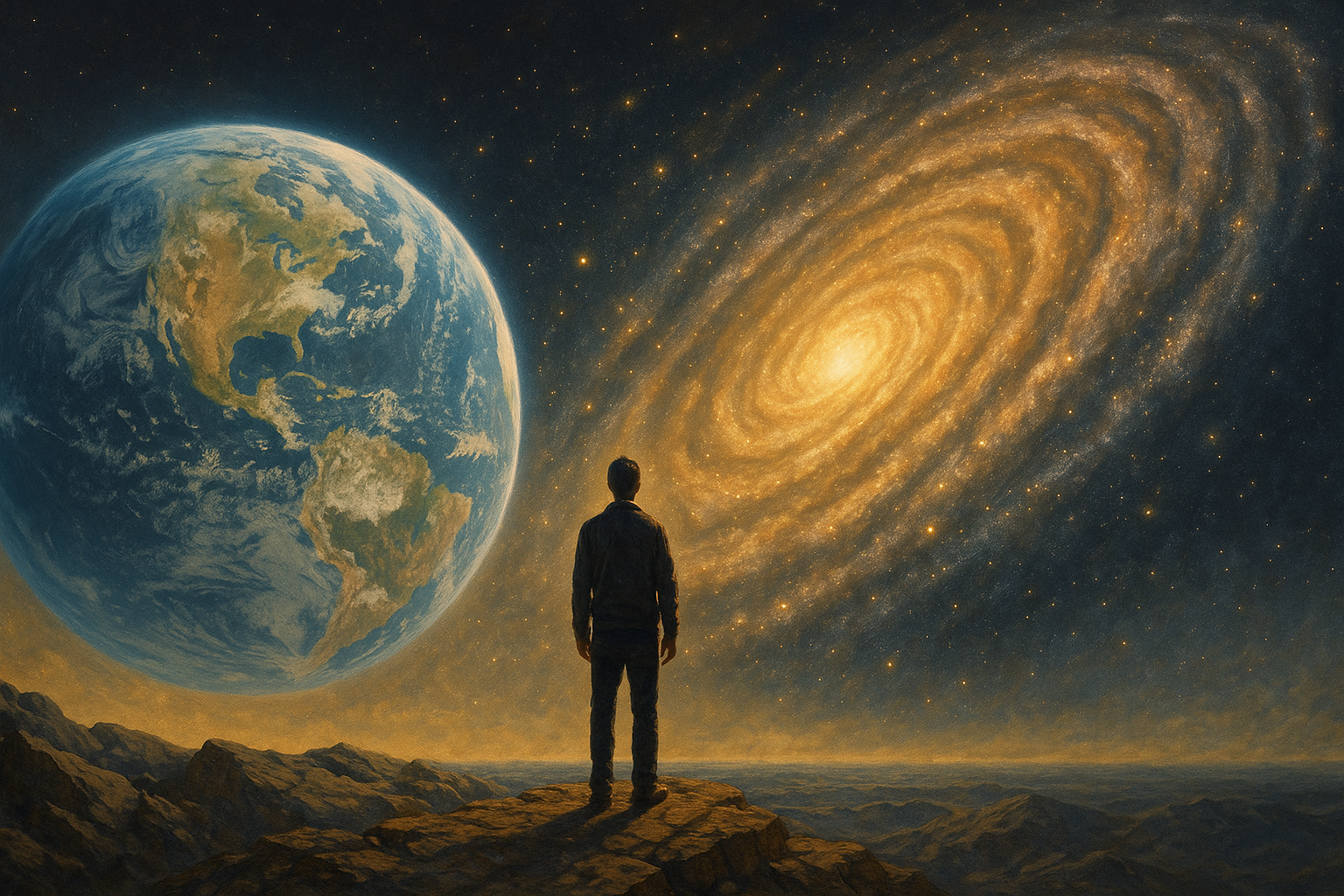
Why do we assume we’re so special? Is it our ability to perceive reality from a unique vantage point? That’s not a failing, by the way. I believe it’s part of what makes us extraordinary. But here’s the twist: we’re extraordinary amongst others who are just as unique. We are rare, yes—but in a vast, complex universe, so is everything else.
This perspective doesn’t diminish us; it elevates us. To recognize ourselves as one among many doesn’t make us less—it makes us part of something far greater. Reality isn’t something we can master or fully pin down, but it’s something we can explore, live in, and marvel at. And maybe, just maybe, the struggle with ambiguity isn’t something to escape—it’s a reminder that we’re part of a universe too expansive, too wondrous, to ever be completely understood.
Many people throughout history who have thought deeply—have come to a similar realizations about our place in reality. Truth may be provisional, but understanding is deeper. Understanding is actionable. When we truly comprehend something, action follows almost effortlessly. The more we understand, the more intuitive it becomes—like muscle memory.
Practice, skill, intelligence—these aren’t just tools for survival; they’re tools for growth. The more we engage, the more familiar we become, and the easier it is to face new challenges. We may feel like we’re living in a world of uncertainty, but it’s built upon a foundation of things that work, independent of belief. If we approach the world with objectivity and honesty, focusing on what is measurable, we create ways to judge progress.
Whether it’s the accuracy of science or the practicality of everyday goals, like keeping weight off after the holidays, these stable foundations anchor us. But we often forget them, instead focusing on uncertainty to survive. Perhaps it’s human nature—an evolutionary response—but it doesn’t have to consume us.
Cognitive studies have shown that we remember and respond to fear more readily than stability (here is just one of many). Fear grabs our attention; it’s a survival mechanism baked into us. Stability, on the other hand, often fades into the background. We rarely notice it because it doesn’t demand immediate action. Think of how we instinctively recall a near-miss car accident in vivid detail but struggle to remember the uneventful, smooth drive the day before.
This tendency to focus on fear and uncertainty may have helped us survive, but it also skews our perception. It can make us forget the stable foundations beneath us—the things we know to work, the anchors in a sea of ambiguity. Not only might we forget about that which is stable in this universe, but it also leaves a bad taste in our mouths as the fear creates psychic discomfort within us.
Things may be uncertain—we face uncertainty every day, every moment of our existence. But if we remind ourselves that there’s much more we can lean on than is uncertain, it won’t feel as scary or overwhelming. It’s one way we can manage complexity in life: recognizing there are anchors, things we can hold on to, even as our understanding evolves.
Whatever we learn, it doesn’t fundamentally change how reality works; it recontextualizes it. It updates our understanding, sure, but the world continues to function as it always has. These anchors—whether scientific principles, personal truths, or practical knowledge—remain, giving us a sense of stability as we navigate uncertainty. It gives us something to hold onto while enjoying the ride.
Related Pages
No other pages link to this page.