Post Fact Pre Grown
 "“The secret of life is honesty and fair dealing. If you can fake that, you’ve got it made.” — Groucho Marx"
I don’t want to write about these topics. Somewhere in my mind I knew I was going to have to though. These things are ‘controversial’. Then again, in the circles of the hard sciences, my claims are also seen as such, but not nearly as emotionally charged. I mean, when was the last time you read a news piece about Thanksgiving being ruined over family members fighting over which interpretation of QM is correct? Never. However, we do have family members fighting each other over political opponents. Have you ever been advised not to talk politics or religion at family functions? They never say anything about mentioning Quantum Mechanics. That seems unfair.
What I want to write about is resonance. I want to write about the geometry of meaning. I want to talk about how everything connects to everything else. How we are all in this together. Let’s share recipes and tips. You know, the fun stuff. The stuff that gets me out of bed in the morning because it’s genuinely exciting and I think it matters. I bet there are things like that for you too.
But I can’t. Not yet. Because there’s something in the way, and it’s not a technical problem or a gap in the literature. It’s us. It’s humans. It is our broken systems. And until we deal with it, anything I write about the fun stuff is going to land on ears that aren’t ready to hear it — or worse, get misunderstood by people who react before they read.
So here we are. One of the pieces I have to write before I can write the pieces I want to write. And yes, I am aware this is long— I don’t dictate the length. It is as long or short as it should be. That is what I tell myself anyway. That said, onward!
Share
Babies!
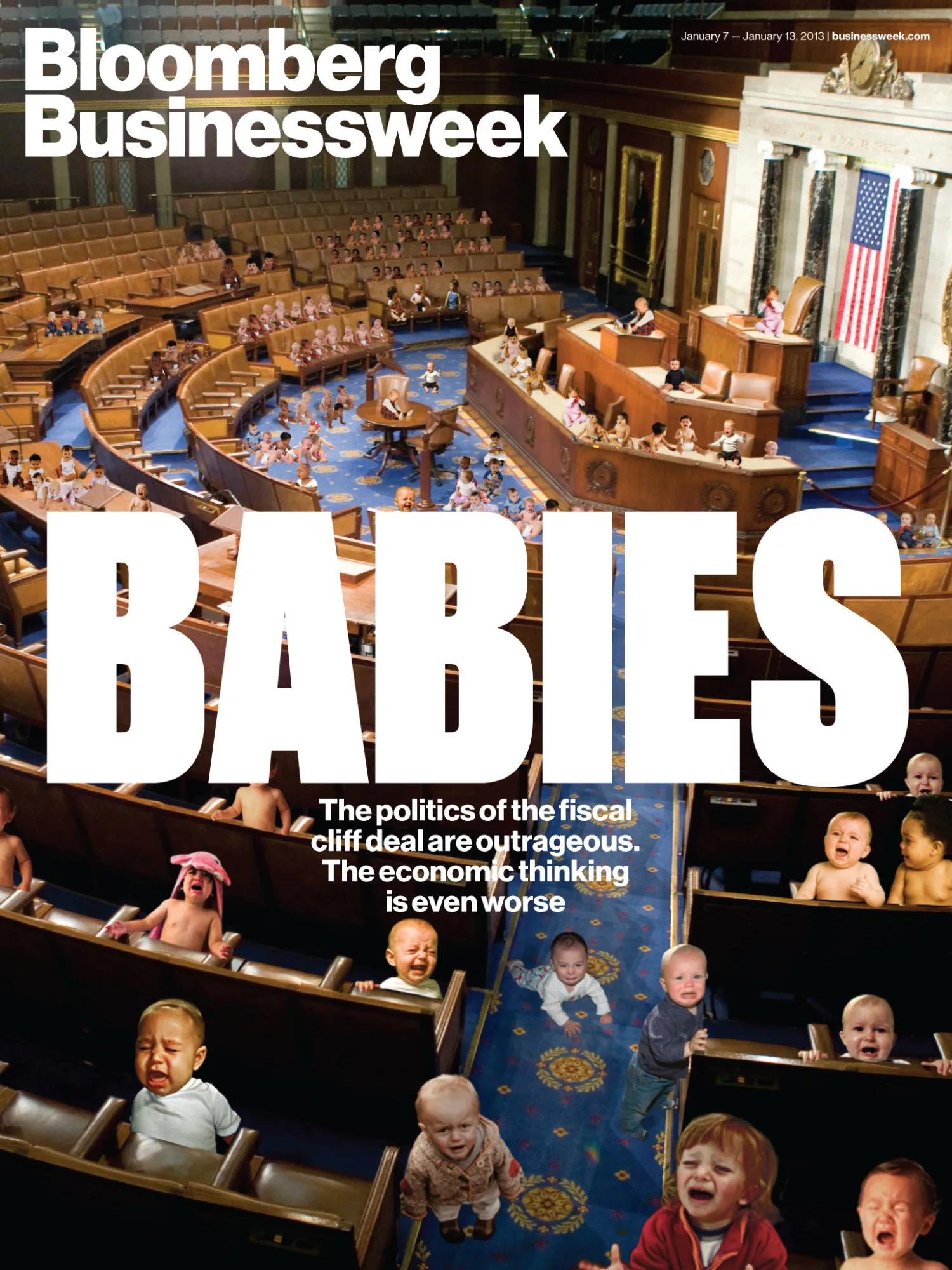
I have this Bloomberg Businessweek cover from January 2013 framed on my wall. It’s a photo of the U.S. House chamber filled with crying babies. The headline, in massive letters: BABIES. The subhead: “The politics of the fiscal cliff deal are outrageous. The economic thinking is even worse.”
But let’s back up a little because this was one inflection point among many during the early 2010’s. In the summer of 2011, during the debt ceiling crisis — the shutdown, the Tea Party standoff, the country watching its credit rating get downgraded for the first time in history — I was on Facebook trying to get my friends to pay attention. This affects us. We are the age where this matters directly. This is our financial future. And do you know what they wanted to talk about instead? The Casey Anthony trial. Was it a terrible story? Yes. Did the courts ultimately acquit her? I believe so — I can’t remember, because I didn’t pay attention. It didn’t affect my daily life. It was horrible, and it matters in terms of case law. It was something I had no control over and could pay attention to later if I needed to. But my daily life at the time? The economy was collapsing around us- it had been since 2008. And my peers chose the story that was entertaining over the reality that was scary.
I was shunned for pointing this out. I was blocked for it (ironic?) I was the problem on Facebook — because I was focused on what was actually happening to us instead of what was happening on TV. Was I abrasive? Probably, but anyone ruining your fun is going to be abrasive by its nature. There is time for fun and this was not it.
During this time I eventually stopped trying, people just continued to ignore what is uncomfortable for other distractions online and in the media. 2013 rolls around and Bloomberg puts babies in Congress. Because it was still going on. It had only gotten worse. And it’s been getting worse every single year since. This is why we’re living in the Simpsons. Now in 2026 it is getting very difficult to ignore.
I’m going to say something that some will find controversial: the majority of humans, right now, are behaving as children.
Not biologically. Not in the intellectual disability sense — that is a real thing that real people struggle with, and it is not what I’m talking about. I’m talking about people who are, for all intents and purposes, adults. No disabilities. Full biological maturity. We expect them to act like adults. And then when they act like children, we still treat them like adults instead of treating them like the children they’re acting like.
I want to be precise about what I mean here, because this might be dismissed as moral condemnation if I’m not. I’m not saying people are globally incapable. I’m pointing to uneven development across domains — something developmental psychology has documented extensively. A person can be brilliant in their field and emotionally twelve years old when confronted with disagreement. That’s not an insult. It’s a developmental mismatch. And it’s everywhere. It is like only focusing on your upper body when working out. You can get really strong and look like a bodybuilder, but that does not mean your legs will too unless you focus on them too. Right now I believe we have forgotten our legs, and our legs are what hold us up. Our upper body is too big to be supported. That is a good way to think of it that just popped into my head— I am going to have to develop this further.
Anyway, look around. Look at America right now. If you think I’m wrong, explain it to me. Explain what’s happening without the word “childish” entering your mind at some point. I challenge you to do so. We are forming groups to keep people out on the playground. We are talking about others behind their backs. We are making up clubs — you’re not allowed because you’re not like us. We are taking each other’s toys and calling it policy. No Daniel’s Allowed.1
I know this will shock you, they are like us because they are humans! The only way someone is not truly like us is if they are not human. And yes, anyone versed in the history of racial discrimination and oppression knows this move — when we say somebody is “the other,” it is to dehumanize them. To say they are not human. We know for a fact though that they are human. Period. Even thinking otherwise is strange to me. If you are a mature adult, playing these games seems immature. Because it straight up is. You might not even be aware of it. This is what we have identified as bias. Systemic bias. Unconscious bias. When we play their game, no matter where the bias comes from, we accept their rules, their premises. At that point, it is an uphill battle to correct the behavior.
If an alien species showed up tomorrow and observed us, I have a feeling this is why nobody in the galactic community would want to deal with us. We haven’t grown up yet. We aren’t worth it. And we keep talking like we’re the best as we destroy everything around us. Our hubris reeks of a species too young to understand its place in the cosmos.
And here’s what happens when the adults in the room try to deal with it: they end up stooping to the children’s level. When the children refuse to play by the rules and the adults acquiesce, the children end up making the rules. That’s dangerous. A parent would never let their child run the household. If they do, they’ve lost control, and the child is running the show. That’s not what we want from our governments. That’s not what we want from humanity.
It’s time to grow up.
This Scales
This is not just a Substack problem. Substack is a microcosm of the macrocosm. I can see this everywhere I look. Facebook, the news, government — it’s the same pattern at different scales.
On Facebook, the majority of people don’t see it or understand it, and I don’t expect them to. They’re the average person. They aren’t writing about these things. They’re just fighting and reacting. So I don’t get as upset with them.
But on Substack? People here claim to be intellectuals. They claim to operate at a higher level. And then they block someone for asking a question or disagreeing. That is what children do is it not? They claim the other person is a troll. Yes — children are trolls to each other. But when an adult in the room tells a child they’re doing something wrong, asks them questions, tries to engage — is that adult a troll? The child will see them as such, perhaps not with that phrase of course, and complain to their friends about it, adults are horrible creatures. Adults always ruin our fun, it’s not fair! But in reality the adult is not a troll. The adult is (hopefully) trying to teach and/or protect the child, usually from themselves.
But here’s the problem: if most humans are acting like children right now, who are the adults in the room? There are some. But they keep getting lumped in with everyone else. Just another kid we can treat however we want. And when the adults point something out, the response is: the adults are the ones with the problem. Guess what? Children say that all the time too. Perhaps they are labeled as a danger, or not to be taken seriously. The children in this area are the majority. They don’t listen to their elders as they cannot recognize them as such.
And by the way — Substack itself is an echo chamber. If you only publish here and nowhere else, the only people who see your work are people already on Substack. It’s like a high school paper. Important to the people who go to the high school, maybe a few people outside. But the broader world? They’re not paying attention. And people inside act shocked about this as though they’re participating in some massive cultural moment. Anyone who is serious about publishing their work do so across multiple platforms. They understand each is its own echo chamber.
This is why it’s not unique to Substack. This is a platform complaint — it’s just that every platform has the same problem— not just in software either. Facebook is a closed loop. Twitter is a closed loop. CNN, MSNBC, Fox News — closed loops. Academic departments, professional communities, political parties, institutions — closed loops. Any system where the audience and the producers are the same people, where information circulates internally and rarely gets checked against the outside, is a closed loop. Substack is one of them. The media is one of them. Your government is one of them. I’m naming Substack because it’s the one I’m in, but this is what all of them are doing.
And to be clear — this doesn’t make Substack bad or evil. It’s a design flaw in pretty much all of our systems. Nobody wants to admit that, but it’s been talked about. I’m not the first person to point this out. I’m just pointing it out from where I’m standing.
The Extremes and The Middle
Zoom out from Substack and you see it everywhere speech is allowed. The loudest two extremes dominate. CNN, MSNBC, Fox News — everybody in the world knows the two positions. And when you actually look at the numbers, both the far right and the far left are a very small minority of the population. The majority are independents or moderates or somewhere in-between who don’t agree with either extreme view. And within these views, not all are treated equal- there are individual threads that one might hold to an extreme but not the rest. It is very complicated, but this is the nature of perspectives!
But those people in the middle who hold few, if any, extreme views have basically resigned themselves. I talk to them in my own community. They say: there’s nothing we can do, this is what we are now I guess. The minority looks like they have so much power because they’ve been given so much power. Because we gave it to them. We let them take it without a fight. They came in and took it, and the people who are more mature than the children on the extreme edges just... let it happen. Why? Fighting is not civil. We don’t want to violate their rights, the same rights we enjoy. Let that one sit for a moment.
Any kind of fundamentalism is not going to work. Not necessarily morally wrong — it’s just the wrong answer. It becomes dogma. It becomes certainty bias. You can’t efficiently solve a problem by eliminating diverse viewpoints. Fundamentalism happens (generally) when you lack information and, quite honestly, lack the maturity to see past your current position.2 This is what children do. This is why we don’t always allow them certain rights until a certain age — they don’t have all the information yet. Pretty much all cultures have realized this (to a degree, some more than others). They’re still learning. It’s not just that their brains are underdeveloped. They haven’t been around long enough to have the experience.
The majority of people in the middle have matured enough to recognize this. We know people have the right to say and believe what they want. And we feel it’s not right to call them out — it seems childish to call people out, because we have to respect beliefs. The problem is: I think we’ve misapplied this. We apply it as a blanket because we haven’t fully grown up enough to discern when accountability is required. When someone isn’t just stating an opinion — they’re factually wrong, and it’s going to get people hurt.
Belief Is Free, Consequences Are Not
You’re free to believe whatever you want. That doesn’t mean what you believe is true.
If you believe Santa Claus is real and you tell your kids he is, and then you don’t go out and be Santa Claus for your kids, and you wake up the next morning expecting the tree to be full of presents — it’s not just you who’s going to be upset. Your kids are too. Because you told them it was real and worked a certain way. You adjusted their expectations. They will remember the gap in their expectations you set and the reality of what happened. It didn’t work. That is what they know now, they can’t unknow it.
You can believe whatever you want. But your beliefs affect others. And when somebody points out that you made your kids cry, you don’t get to turn around and say: how dare you make me feel bad? I’m allowed to believe whatever I want. You’re not allowed to tell me what I’m doing is wrong. That’s mean. You’re hurting my feelings. And being a responsible person means accepting my feelings and not hurting me, because real adult people don’t hurt each other. We respect each other’s beliefs whether or not we agree with them. You have to respect mine because that is what mature people do!
Do you see what just happened in this thought experiment (apologies for putting you in the adversarial position, I know that you, the reader, would actually not do this, please just play along)?
All of a sudden, I feel like the child. Because I actually do agree, it is hard to argue with without reinforcing the narrative. Also, who am I to tell someone how to be a parent? So yes, I respect your belief.
However, you hurt your children. I can’t respect that. Intent is not impact. What are the ethics here? Do I point out this inconsistency and risk playing into your narrative, or do I retreat knowing that the pattern is very likely to repeat. How will I sleep tonight knowing that that child might be hurt by something else, potentially more serious?
To note, this situation is absurd (I hope) and I would not act the way I am describing if I found out someone did this to their child. It would break my heart, but without more information I would not be able to infer anything beyond it. Like most thought experiments, it is meant to demonstrate a point.
The point is: seriousness is a performance. Rigor is a practice. They are not the same thing, and most people are doing the first while claiming the second. Accepting something factually incorrect is not rigor but it might look serious. It might look professional. This does not mean correct or accurate.
Performance looks like: signaling certainty, dismissing questions, defending your identity when your ideas are challenged. Practice looks like: checking your claims against evidence, tolerating disconfirmation, updating your model when the data says you’re wrong.
If you were being rigorous about Santa Claus, you would check. You would realize you have to do stuff. Otherwise you’re being negligent. Negligence causes harm. It can have the same impact as intentional deception. I believe this is a key factor to why many confuse the two.
The Problem of Words
I’m a firm believer that words mean things. Over the past ten years, people have just stopped believing that. They believe words mean whatever they want them to mean.
No. They mean things. Specifically.
Now — I want to be clear about what I’m not saying. Languages evolve. Meanings shift over time. That’s semantic drift, and it’s a natural, well-documented process. The word “nice” used to mean “foolish.” The word “awful” used to mean “worthy of awe.” Nobody owns a language, and nobody gets to freeze it in place. That’s not what I’m talking about.
What I’m talking about is something entirely different: private redefinition presented as shared meaning. This is when one believes their epilanguage is universal. When somebody uses a word, assigns it a meaning that is theirs alone, and then insists that anyone using the word is using that meaning — that’s not language evolving. That’s someone opting out of the shared reference system that makes communication possible in the first place. Language works because we agree, roughly, on what words point to. It’s a coordination mechanism. When someone refuses that coordination and insists their private definition overrides the shared one, they haven’t made a linguistic argument. They’ve broken the tool we use to talk to each other. Communication fails because the participants are speaking two different languages. Literally.
I’ve had discussions with linguists on this platform. I was blocked by a self-proclaimed linguist. I’ve had interactions with a trained linguist who told me that questions violate their boundaries and they don’t like it. So they stopped talking to me. Because I ask questions. On a platform built for asking questions. Let that sit.
I understand that questions can be ‘triggering’. I need to stop here and talk about that word, because it’s a perfect example of exactly the problem I just described. And it is one I have to deal with daily as someone with an illness that can be triggered.
When most people say “triggered” right now, they mean: this made me uncomfortable. This offended me. This upset me. I am charged or hurt. That is not what triggered actually means. That is not what the term refers to. Being offended is not being triggered. Disagreeing with somebody is not being triggered. This is semantic drift in real time, one that experts have been shouting about for years now. It does not stop it from happening though, as we can’t control language in that way.
Triggering, in the medical sense — the actual meaning of the term — is a physiological response that a person does not have control over. It is not optional. It is not a choice. It is not a feeling, it is an emotion. It is not “I didn’t like what you said.” It is a flood of adrenaline and cortisol and other stress chemicals that the body produces involuntarily because it learned, through repeated exposure, that a particular stimulus means danger. It is torture. It forces the body to experience it literally as it did the first time. It is not a memory, it is a recreation. It is the same category of physiological response as an epileptic seizure triggered by flashing lights — different mechanism, different location, but the same involuntary, damaging, uncontrollable nature.
And nobody makes fun of epilepsy trigger warnings. Nobody says: well, maybe they should just toughen up about the flashing lights. Nobody accuses them of being too sensitive. Well, some might, but they get shunned fast, as they should! But when it’s a trauma response? Suddenly it’s fair game and we look the other way.
As I have previously disclosed, I have CPTSD. When I say something triggers me, I am using the medical term. One of my triggers — an actual one, a physiological one — is inconsistency. People who say one thing and do another. Why? Because that is what gaslighting is. That is the pattern my nervous system learned to flag as danger through years of experience. When somebody presents as one thing — these are my morals, this is what I stand for — and then does the opposite, my body responds whether I want it to or not. It is dishonesty, independent of intent. You cannot trust something that deceives in that manner. The thing is, the trigger is not because it I am misunderstanding something, that is called a hallucination, of which I do not have. I am being triggered by the actual mechanism. The reason for that, the intent behind it, whether someone is aware of it, is not important. Someone intending to deceive others to cause harm triggers me the same as someone who is woefully misinformed but means well.
And I had to learn to handle that. I couldn’t expect the entire world to stop being inconsistent just for me. That would be ridiculous. I had to actually do the work — rewire my brain, get past the automatic response, learn to function despite the trigger. That’s what people with real trauma have to do. We don’t get to demand that everyone else change. We have to change ourselves. And it’s the hardest thing I’ve ever done.
But here’s what I see: people who have not experienced trauma in this way — people who may have had difficult things happen to them, but healed normally, whose perspective didn’t get permanently skewed, who didn’t have to rewire their brain to get back to baseline — they use the term “triggered” to mean “offended.” And then they demand that others change for them. They have the privilege of not having to do the actual work. They get to say “you triggered me” when what they mean is “you made me uncomfortable,” and then they expect the same accommodation that people with genuine trauma responses need.3
That is not the same thing. I’m watching people who haven’t dealt with the harder difficulty level skip straight to demanding accommodation for discomfort they could address themselves if they chose to. It’s like playing a game on easy and reacting poorly when you die and get a game over. The poor behavior might look like throwing the controller and blaming the game for being unfair. Then the one who beat it on expert points out that it is probably not the game, it is the player and they respond, again poorly, that just bringing it up is unfair, pouring salt on the wound. If you have ever played games, I am sure you have experienced this like I have. From both sides possibly.
To clarify, I am not talking about people who have survived real trauma. They are in the same boat I am, and I have nothing but respect for them. I am talking to the people who haven’t — who use these terms without understanding what they actually mean, and who talk like they understand something they don’t.4
So when I say I understand that questions can be triggering for the linguist I mentioned — I mean it. If questions are genuinely a trauma trigger for them, I understand that completely. But the response — applying it as a blanket to anyone who asks anything — is the same pattern. You made me feel uncomfortable. Therefore, you’re the problem. Not realizing that maybe I’m not the problem. Maybe the fact that your brain learned this association is the actual issue. Only you can address that by sitting there and asking: is this person actually trying to hurt me, or are they just asking a question? Context matters. You can only get that by gathering more information. You actually have to do work to do that. Many just move on, because it is too much work. Is it though?
When I use a word, and someone tells me that word doesn’t mean what I think it means, and I cite the dictionary, the response is not “well, that’s just the dictionary term.” That would at least be a disagreement about meaning. No. They imply the word doesn’t mean what the dictionary says it means. They tell me I’m wrong for citing it. I understand it is a reaction, doubling down because they might not have realized they had the word incorrect, and that can be embarrassing. It happens to all of us. We used to acknowledge the error and move on. Instead, this is starting to happen:
They say their meaning is the only meaning.
That’s it. That’s the move. Not “my truth and your truth.” Not relativism. Not “let’s agree to disagree about definitions.” Their meaning is the only meaning. Period. Anyone else just can’t understand. The dictionary meaning is just one of them. It is their interpretation of what it means that is real. Because their interpretation has become the meaning that matters, it is the meaning that makes most sense, and is the easiest to grasp. Even if that meaning is already defined, there must be ‘hidden’ meaning we have to decode. After all, we have a branch of linguistics that studies exactly this subject, it is called pragmatics.
Circling back though. when you have to quote the dictionary as your defense, the person quoting the dictionary is usually not the problem. Unless you are playing scrabble. Then it depends on house rules.
Feeling Versus Happening
I keep coming back to this: somebody can be mentally an adult in most areas but immature in others. None of what I’m saying is outside the realm of current cognitive science, neuroscience, developmental psychology, and adult psychology. This is not bizarre. This is not massively out of the ordinary.
There are (at least) three things that people constantly collapse into one, and it’s worth naming them clearly because the rest of this piece depends on the distinction:
Emotions are what your body does in response to stimuli. They’re real. They’re yours. They are not optional. They are your experience of what is happening. Our internal interpretation of that is called feelings. I have covered this in a previous piece.5
Interpretations are the stories you build around those emotions and feelings. They may feel automatic, but they’re constructed. Your brain generates them. They can be wrong. They might be neither. Opinions co-mingle with interpretations here.
A fact represents what actually happened, independent of how you feel about it or what story you built because of it. It is true independent of belief, and (in theory) can be independently verified.
When someone says “you’re being aggressive,” they may be reporting something they experience (I feel threatened), stating an interpretation (your behavior is aggressive), or asserting a fact (you are, measurably, doing something aggressive). These are three different claims. Treating them as identical — which is what most people do — is where everything breaks down. The feeling is real. The interpretation might be wrong. The fact needs to be checked.
But here’s where it gets personal.
People have told me, throughout my life and recently on this platform: everything is trauma to you. Everything is emotions to you. And my response is: yes. Not because I believe it from my experience — because that’s what the cutting-edge research says. The people who study this, who have more information than I do, who are experts — that’s what they’re finding. I don’t trust my own opinions. They’re biased. I default to empirical evidence, to what is established, to what works independent of anyone’s belief, including mine. My rule is simple: when my internal state conflicts with external evidence, I side with the evidence. Every time. That’s the whole practice.
And people still misunderstand. They still come at me as if I’m just stating opinion. What I want to be true. That it’s an excuse for why I don’t fit in, that it is being used to justify my poor behavior is not the case here. And yet, this very argument is used to excuse and justify any poor behavior I might point out. Interesting how that seems to work is it not? I know I am not the first to recognize this pattern.
I’m abrasive. Yes. Sometimes. But sometimes what feels abrasive is not actually abrasive — people just haven’t built up a tolerance for directness or truth. And here’s the thing: I have sensory processing sensitivity. I am clinically highly sensitive. I am an empath to the max because of it. It is a challenge to distinguish my own emotions from everybody else’s on a regular basis. If I was somebody insensitive, callous, and unempathetic telling you to toughen up, maybe you could discard it. But this is a call coming from inside the house. Somebody who struggles to separate their emotions from everyone else’s is telling the human species: you’re being too emotional right now. The scientific evidence seems to point this way too.
When Not An Overreaction
When people who don’t appear emotional tell me I’m overreacting, I sit there and think: no. I’m actually reacting normally. Also, who are you to tell me how I should react? Framing it as overreacting is exactly the pattern I’m describing. An emotional reaction is when you assign your feelings to what someone else is doing. Let me be clear. When someone tells you this, tells you what you are feeling or how you are reacting, they are assigning how they would react in the same situation and expecting you to conform to it. The baseline is how they would react, not how anyone else would.
Even if they empathize, and realize that the majority will react a way they don’t, when they tell you “well, it can be taken this way, so you should to change it” — that’s the exact issue. Many can realize that how things look, how someone reacts to what you say is more important than what you actually say. When dealing with controversial topics, it’s better to just not discuss because of how many may react, without thinking, to your words based on how they want to interpret them.
And I’ve been told I should rephrase things. That what I’m saying is controversial (and not just here, my physics and math ideas have people wanting to basically burn me at the stake for heresy). Here’s the thing about that: the main reason does not seem to be because I’m wrong. It’s because it could be read incorrectly. Because people will take surface-level things and react.
I refuse to change it. Why would I change it when that’s exactly what I’m fighting? Changing it is the problem I’m identifying. Acquiescing to how somebody may perceive something because they didn’t do their due diligence is not my fault. Writing that way ensures the message doesn’t get through because it never challenges anyone. And we only learn and grow when we feel uncomfortable. This is a training issue, not something that can be solved with design.
When we are comfortable all the time and we don’t run into problems, we are stagnant. We wither and die. Challenge is part of life. How many people pick challenges they want versus challenges they don’t? A new hobby — I’m bored, I need something new. That’s putting yourself in an uncomfortable, uncertain situation. But because you chose it, it’s not scary. The thing is, we believe we have the privilege of picking and choosing all the time. If you just accept that you can’t pick and choose everything, you don’t have issues when you don’t get to choose.
I think children are generally more resilient because they are told from the start they don’t get to choose. Once the child becomes an adult, they seem to think they can. This makes the adult less resilient.
Boundaries, Rules, and Gaslighting
You can set boundaries. Boundaries only work if everybody else agrees to respect them. You can say it’s right or wrong that people disrespect your boundaries, but those are your subjective boundaries. People can choose not to play your game. I am not saying that is OK by any means, just that it is a reality of life. Most of us agree to the rules, we have punishments for those that don’t want to follow them, but that happens after the rules are broken, after someone violates someone else’s boundaries.
I want to share a story about when I first ran into this.
In the nineties, in middle school and high school, we had AOL Instant Messenger. AIM was the way to talk to people online. There was really no other option — at least not where I was in the United States. And AIM had this feature: it could log your conversations.
This is when I first encountered the phenomenon I’m describing in this piece. I would talk to my friends, and on one day they would say one thing. A few days later, they would say the complete opposite and act like I had agreed with them, actively re-writing the narrative. Now, this also happened in person. But in person, it didn’t feel as jarring because you were in the flow of interaction — you could hear tone, read body language, adjust in real time. Usually, one would get away with it and it would become the shared reality. On AIM though, it was just text. No voice. No face. Just words on a screen. And people are more brazen in text. They make stronger claims. They hold to things more rigidly. We know this effect.
So when someone would say something that contradicted what they’d said before, and I’d go — wait, that’s not what you said — the response was: well, that’s just your memory. We just differ in opinion. And here’s the thing: unlike in-person conversations where maybe you do just agree to disagree because neither of you has a record, I could pull up the transcript. So could they. It was right there.
And there were times I checked and I was wrong. In those cases, I said nothing. Because I was wrong, and I had just verified it. That happens. Humans have terrible memories. This is why eyewitness testimony doesn’t carry the same weight as other forms of evidence — because it’s faulty. Memory is faulty. We know this. That’s why I checked. I checked because I wanted to know if I mis-remembered or not.
But when I checked and they were wrong — when the transcript was right there, showing exactly what was said — and I brought it up? It ended relationships. Not because I was attacking them. I was genuinely confused and trying to figure out what actually happened. But the response was: you’re trying to hurt me. You’re invalidating my reality. You’re looking too much into it. You’re crazy. Anything under the sun. Everything except looking at what was actually said. And it could have been fixed with a simple, oh, my bad, I misremembered. I am sure I did the same thing. I was not accusing anyone of bad faith or malicious intent. That is how it is usually received though.
I learned very fast not to do that (it has taken decades to unlearn this). And at the time, I thought — this is childish behavior. That’s what my parents told me it was. That’s what my teachers told me it was. And that’s what it was called in the developmental psychology courses I took — I was a psych major for years before I changed to business. The behavior had a name, and the name was: this is what children do.
Now it’s decades later. Adults are doing the exact same thing. The same pattern, the same reactions, the same refusal to look at the record. The reason I see it as childish behavior is because that is literally what I was taught this behavior is. Not by my own interpretation — by the field that studies it.
I ran into this pattern again recently with empirical evidence. I introduced something incontrovertible — like catching somebody red-handed, on video, hand in the cookie jar — and they looked right at me and said: I’m not stealing the cookies. You’re seeing things.
This is gaslighting. And gaslighting does not have to be intentional. Denial is a form of gaslighting. We have confused intent and impact. Lying requires intent. Dishonesty does not. When I say somebody is being dishonest, people may think I’m calling them a liar. I’m not. These are different words that mean different things. Which brings us right back to the words problem. Claiming a lie comes with a higher burden of proof, you must prove the intent. You don’t with dishonesty.
The Wrinkle
I want to address something directly because I know how it will be read if I don’t — and I know it’ll be read that way anyway, which is the entire point.
I saw a note from a prominent Substacker about how men in positions of power discriminate against women through language and power structures. I agree that this happens. However, it was framed as something only men do. My experience as a white man working for a group of white women who were in power — liberal, educated women — is that they treated me exactly as she described being treated. I might be a wrinkle in her thesis.
I commented saying I agree, however — and then I asked a question. Is it really gender, or is it who has the power? That’s a question, not a position. I would genuinely like to know if the data supports one over the other.
I am sure it will be read as a man defending men. Which is the pattern. People assign meaning based on what they assumed about me, not based on what I actually said.
Here’s the irony: I am not protecting men. I’m refusing to let my bias determine the conclusion before the data does. That’s rigor. That’s what I keep saying I do. And it keeps getting misread as the opposite.
And I should address this too: I’m a white man with a known mental illness. I’ve been labeled that way since I was seventeen. I should have white man privilege. I don’t, not entirely. Within the manosphere, I’m seen as defective. They can smell it. I’ve been treated like a child — and if you’re treated like a child inside a system that treats women like objects, what privilege exactly am I wielding?
I’ve been called “the big angry man” when I wasn’t angry. I was defending myself. I’ve been accused on this platform of going after strong, established women. If anybody actually knew me, they’d know I basically think women should be running the show. That’s my personal opinion. I don’t know if the science bears it out. And I won’t let my opinion become my conclusion because that would be the exact bias I’m writing against.
But my experience, even filtered through that bias, still points me toward men being the bigger problem. So no — I’m not defending the manosphere, or men. We are the bigger problem and I have known that most of my life. I’m using my platform precisely because it would be ten million times worse for someone who isn’t a white man in my position. And my position is already horrible. I can only imagine what it’s like for them. So why wouldn’t I be an advocate? That is what I am attempting. Whatever privilege I have should be put to good use. I just hope I can help move the needle.
The Post-Fact Era
We are now in a post-fact era. I’m not the only one who has written about this. I’ve read others write about it. Facts do not matter to people anymore because everyone is running on feelings and opinion.
And so the people in the middle — the ones who have matured enough to see the pattern — they swallow the facts. They don’t correct. They don’t push back. Because in order to avoid confrontation and keep everyone happy, they allow falsehoods to perpetuate. The teacher or the expert doesn’t say: I don’t want to hurt your feelings, so yes, I’ll let you believe what contradicts my expert opinion.
No. In the real world, reality is real. You have to accept it. If we’re talking about opinions, yes — we respect differences. But we are no longer talking about opinions. We are talking about facts being treated as opinions. And the people who should know better — the intellectuals, the self-proclaimed experts, the ones who claim rigor — are the ones also doing it, but from a different register.
This is not acceptable to me. And the fact that people haven’t built up the tolerance for hearing it tells me they are immature in this area. That’s where they’re being childish. And metacognition — the thing that intellectuals should have — is what allows you to distinguish “I feel patronized” from “I am being patronized.” Those are two separate things. Collapsing them into one is the childlike behavior I’m talking about.
And feeling patronized when someone’s not patronizing you? That’s not the other person’s problem. That’s yours.
Truth Hurts Sometimes
I can hear it now. The people telling me I shouldn’t say this. That I should rephrase it. That it’s going to be controversial. I already know. It does not mean we avoid the issue, someone has to have these conversations.
Ultimately this has an added layer of controversy because people don’t like being told they’re acting like children. That doesn’t make it wrong. It makes it uncomfortable. And as I just said — growth requires discomfort.
I grew up being taught that to grow up meant you have to do things you don’t like. You’re sick, you still have to perform. The show must go on. That is part of being an adult. And if that sounds harsh, it’s because we have collectively forgotten what it means to be one.
We cannot only learn and grow when we feel uncomfortable and then simultaneously demand to never be made uncomfortable. Those two things cannot coexist. Pick one.
I said at the beginning that I don’t want to write this piece. That’s true. I want to write about resonance and meaning and the geometry underneath language. But if we can’t agree on what words mean, if we can’t distinguish feelings from interpretations from facts, if we treat evidence as opinion and opinion as identity — none of that work will transmit. This piece is not a detour. It’s clearing the epistemic space so the actual work has somewhere to land. Sometimes we have to do things we don’t want to in order to get to what we want to do.
The fun stuff is coming. But first, we have to grow up.
Sources:
[1] L. Feldman Barrett, How Emotions Are Made: The Secret Life of the Brain (Houghton Mifflin Harcourt, 2017).
[2] C. S. Dweck, Mindset: The New Psychology of Success (Random House, 2006).
[3] Daniel Grey, “The Architecture of Scientific Stagnation,” The Indeterminate Reality (Substack), 2026. https://tiocs.substack.com/p/the-emotional-architecture-of-scientific
[4] Daniel Grey, “How Einstein Held Himself Back,” The Indeterminate Reality (Substack), 2026. https://tiocs.substack.com/p/how-einstein-held-himself-back
[5] Daniel Grey, “We Forgot How to Leave,” The Indeterminate Reality (Substack), 2026. https://tiocs.substack.com/p/we-forgot-how-to-leave
[6] D. Kahneman, Thinking, Fast and Slow (Farrar, Straus and Giroux, 2011).
[7] T. Kuhn, The Structure of Scientific Revolutions (University of Chicago Press, 1962).
[8] L. McIntyre, Post-Truth (MIT Press, 2018).
[9] J. Metcalfe & A. P. Shimamura (eds.), Metacognition: Knowing About Knowing (MIT Press, 1994).
[10] S. Sarkis, Gaslighting (Da Capo, 2018).
[11] B. van der Kolk, The Body Keeps the Score (Viking, 2014).
[12] E. Vora, The Anatomy of Anxiety (Harper Wave, 2022).
[13] P. Walker, Complex PTSD: From Surviving to Thriving (Azure Coyote, 2013).
Currently Resonating:
- Sum 41 - Hyper-Insomnia-Para-Condrioid (Does This Look Infected?)
- Architects - When We Were Young (The Classic Symptoms of a Broken Spirit)
- Hand of Juno - Destroy the Line (Psychotic Banana)
- Chiodos - All Nereids Beware (All’s Well That Ends Well)
- Green Day - Stuck With Me (Insomniac)
- Dreamshade - Dreamers Don't Sleep (Vibrant)
- Porcupine Tree - Blackest Eyes (In Absentia)
- Bayside - Devotion and Desire (Bayside)
- Avatar - Captain Goat (Don’t Go Into The Forest)
- Hollow Front - To the Ashes (Single)
*I have left off my comments on the tracks, I think it is more fun for those interested to take a listen and see why these might be resonating now.
As a child I experienced this first hand. I think others have. I know Homer Simpson has, with the ‘No Homers Club’ (classic). Despite experiencing it as a child, this reference was meant as a joke only. And I think it is a pretty funny one. If you know what I mean, you know what I mean.
I am not talking about intentional acts of fundamentalism— ones created in order to exert power and control. I am referring to how these systems can form without intent.
They use boundary talk to justify it. I call it ‘therapy speak’. What is odd, I see those employ this type of speak to those who are doing the real work. I rarely see it from those who are doing the work. Why? They seem to understand how harmful this behavior is, not just for them, but others as well.
I’m not saying people are intentionally co-opting these terms for an agenda. I’ve seen linguists frame it that way — “people are co-opting this language” — and that framing implies intentional misuse, which starts sounding like conspiracy talk. I don’t believe in conspiracy theories. They are so unlikely to hold up at scale. Obama put it perfectly in his recent interview with Colbert about the UFO releases — if something that big were being hidden, somebody would have taken a selfie by now. People are terrible at keeping secrets of that magnitude. For a conspiracy to hold, the majority would have to be in on it, and if the majority is in on it, it’s no longer a conspiracy — it’s the norm. So no, people aren’t co-opting “triggered” on purpose. They’re just using a word they don’t fully understand because they heard it used loosely and never looked it up. Which is, again, the words problem.
Please see The Architecture of Scientific Stagnation
Related Pages
No other pages link to this page.