The Cosmic Instrument
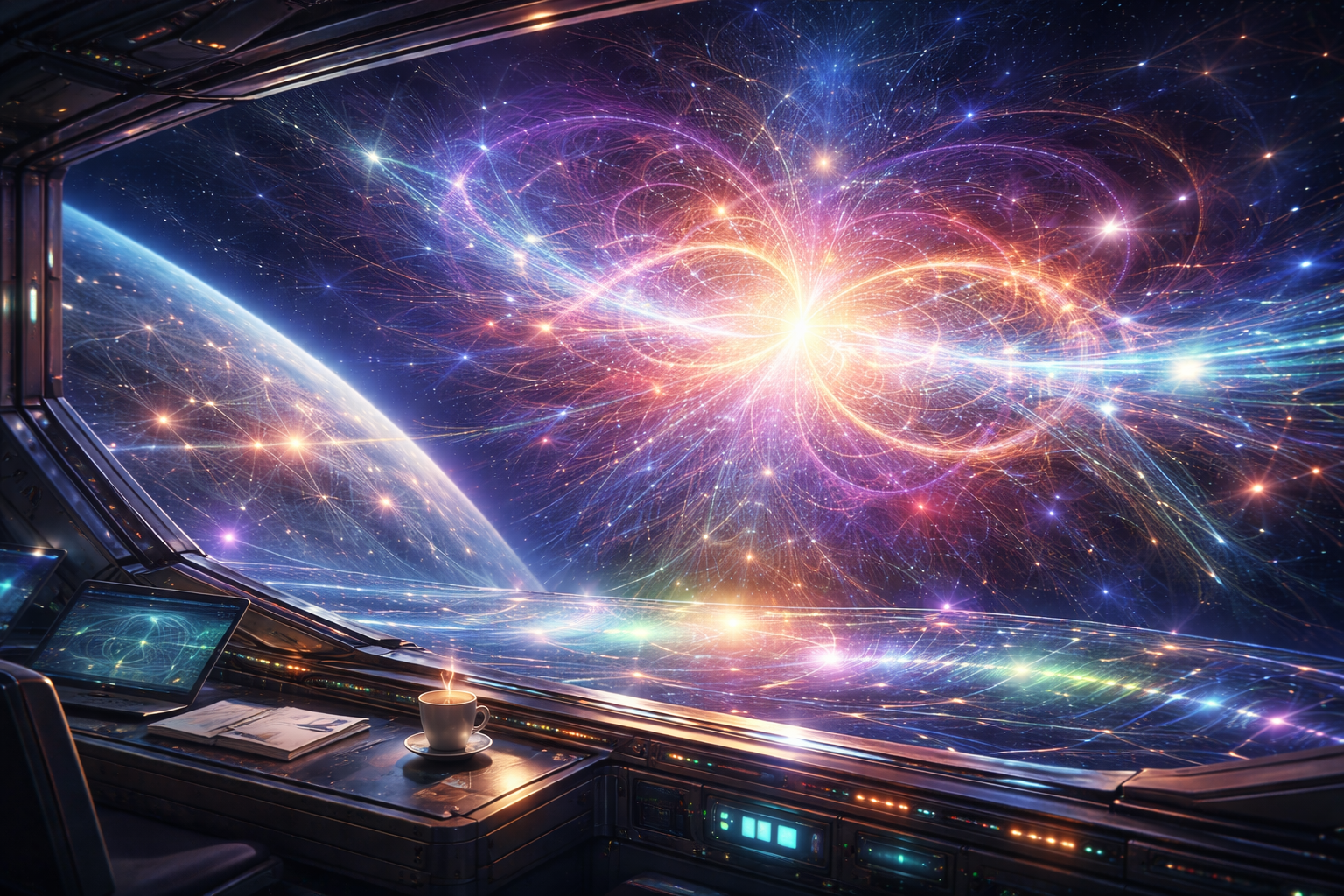 Dr. Elena Rodriguez had spent seventeen years studying reality, but it wasn’t until she watched her daughter’s first piano recital that its architecture finally clicked into place.
She stood at the observation deck of the Meridian research station, the holographic data streams temporarily forgotten, her mind circling back to that evening three months ago. Maya’s small fingers hovering over the keys. The moment before the first note.
The music doesn’t exist yet, she had realized, watching her daughter’s hands tremble with anticipation. The piano contains every possible song—every symphony, every jazz improvisation, every melody that will ever be composed—but none of them have being until the moment of performance.
Now, staring at the interference patterns blooming across her display, Elena understood she was looking at the same principle writ large across the fabric of spacetime itself.
“Dr. Rodriguez?” Her research assistant, Kenji Newman, appeared at her shoulder, his tablet clutched against his chest. “The new readings from the array. They’re... I don’t know how to describe them.”
“Show me.”
The holographic projection shifted, revealing a cascade of probability matrices that made Elena’s breath catch in her throat. The pattern was unmistakable—a bounded system, complete and self-contained, yet generating infinite unique expressions with each measurement event.
“It’s an instrument,” she whispered.
Kenji frowned. “I’m sorry?”
Elena pulled up the mathematical framework she’d been developing in secret for the past six months, the equations she hadn’t dared share with the review board. “Look at the structure. All possible states—inputs. All possible transformations—the operators, the dynamics. All relational mappings—how the states connect to transformations…”
She traced the geometric constraint hovering in amber light: a² + b² = 1
“The system is complete. It normalizes to unity. A closed, singular totality containing everything needed to generate any possible expression of itself.” Her voice grew quiet with wonder. “But the expressions—the measurement outcomes, the collapse events, the moments of actualization—these emerge fresh. Each one. Every time.”
Kenji studied the data, his skepticism slowly giving way to something closer to awe. “You’re saying the universe doesn’t store its outputs. It derives them.”
“Exactly.” Elena zoomed into the interference pattern, highlighting the delicate interplay between possibility and actualization. “If every possible state already existed as a concrete reality, you’d need infinite storage. Infinite energy to maintain coherence. And worst of all—” she turned to face him, “—nothing would be unique. Nothing would be created. Every measurement would just be retrieval. Every moment would be replay.”
She thought of Maya again. The silence before the first note. The piano containing all possible music, yet producing none until those small fingers finally descended.
“The mathematical completeness doesn’t eliminate novelty,” Elena said, her voice barely above a whisper. “It enables it. The constraint ensures the instrument is whole, bounded, complete. And precisely because it’s complete, it can generate infinite unique music without contradiction.”
Kenji was quiet for a long moment, processing. Finally, he asked, “So what does that make us? Observers? The Audience?”
Elena smiled—the first genuine smile she’d allowed herself in months.
“We’re the performers,” she said. “I don’t think reality consists of watching a pre-recorded film, Kenji. It’s more like playing an instrument that no one else has played before, let alone mastered.”
She reached toward the holographic display, her fingers hovering over the probability matrices the way Maya’s had hovered over the piano keys.
“There’s a moment before measurement. Before collapse. Before solidification. The outcome doesn’t exist yet. The system is ready—completely ready, still with capacity for an unknown number of potential results. But the actuality has no being until the performance.”
Her hand passed through the light, and the wave resolved into a single, definite state.
“This is what it means for outputs to be derived, not stored. This is what it means for a system to be complete without being predetermined.” Elena watched the new data cascade across the display—unique, unrepeatable, fresh. “This is what it means to contain infinite potential within finite form.”
She turned back to the observation window, where the stars hung ancient and patient against the void.
“The universe is always being played,” she said quietly. “And every moment is a note that never existed until now.”
Related Pages
No other pages link to this page.