Out of Time
 “You see things; you say, ‘Why?’ But I dream things that never were; and I say ‘Why not?” ― George Bernard Shaw, Back to Methuselah
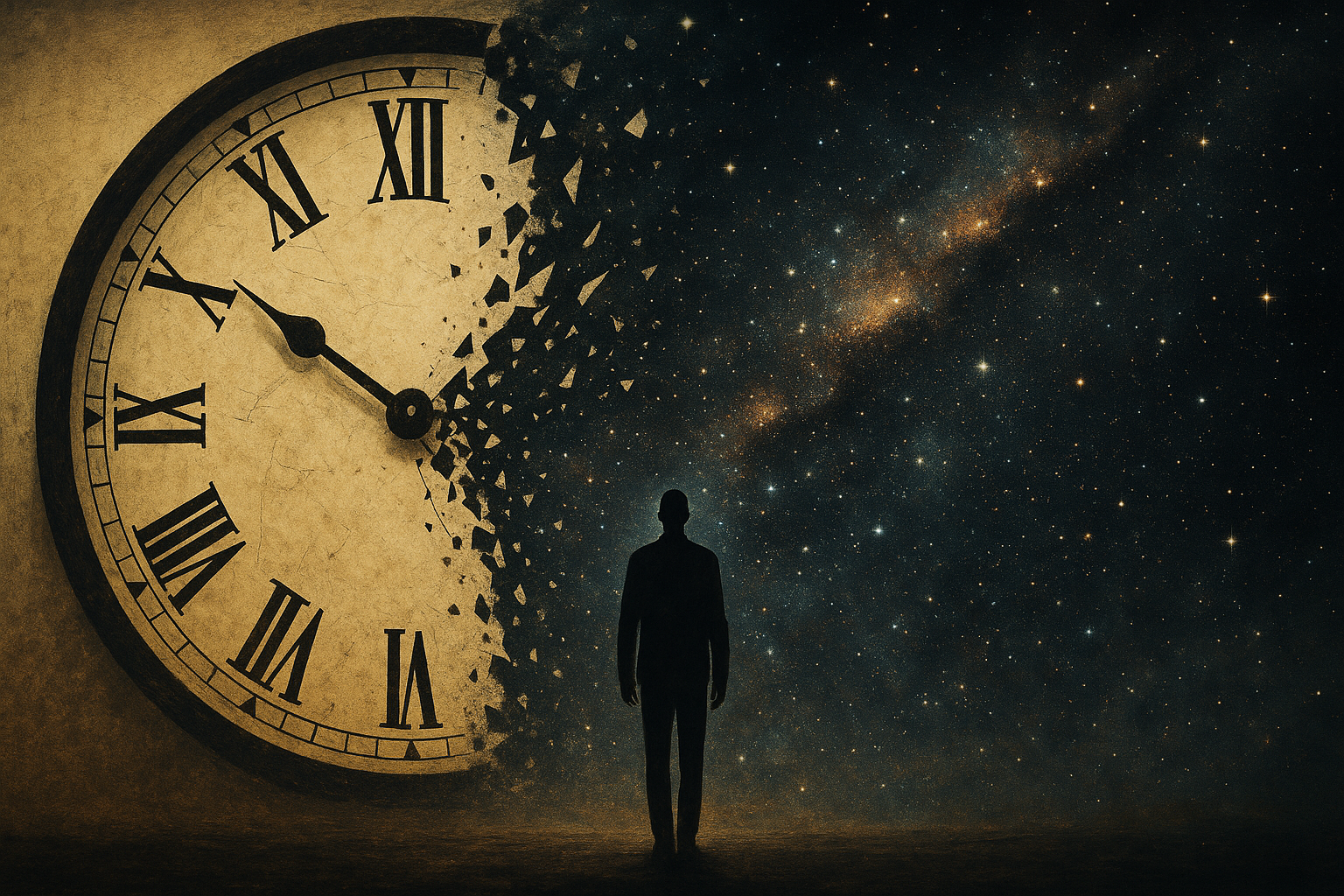
There’s a peculiar tension in feeling “out of time.” It’s not about being ahead or behind—it’s about moving to a rhythm that others don’t seem to hear. For as long as I can remember, I’ve felt this way: slightly out of sync, like a note in the wrong key or a shadow cast by a light that hasn’t quite reached its source.
This dissonance isn’t random. It stems from a philosophy I’ve carried with me my entire life. At its core is a single guiding principle: the only certainty is uncertainty. This idea, merging the Socratic mantra “The only thing I know is that I know nothing” with Heisenberg’s Uncertainty Principle, has shaped the way I see and engage with the world. It’s a mindset that refuses to settle for absolutes, embracing paradox and provisional truth instead.
Over the past ten months, this philosophy has crystallized into something larger, guided by relentless curiosity and a desire to understand the deeper patterns of reality. I’ve explored ideas that challenge traditional frameworks, weaving concepts from numerous disciplines into a cohesive mental model of reality. It’s been thrilling, humbling, and terrifying all at once.
But this process isn’t just intellectual—it’s deeply personal. My explorations aren’t about abstraction; they’re about navigating the world. The patterns I see and the questions I ask shape how I live, how I connect with others, and how I understand myself. And yet, sharing this perspective often feels isolating. The solutions I see, the gaps I notice between problem and execution, seem vivid and urgent to me. But for many, these ideas are either too abstract or arrive too soon to resonate.
This isolation isn’t just about being misunderstood—it’s about the weight of uncertainty. The framework, the philosophy, that way of seeing the world, is also how I navigate it. If it’s wrong, it’s not just an intellectual misstep; it’s a fundamental disruption of how I relate to reality itself. And while I can see coherence in the patterns and connections, translating them into something concrete—something others can engage with—often feels like an impossible task.
And yet, this pursuit is not about resolution. It’s not about “putting it all together.” In fact, I hope I never do. Because the beauty of uncertainty, the thrill of paradox, lies in the questions themselves. Certainty is static; uncertainty is alive. To me, the gaps—the spaces between understanding and explanation, between problem and solution—are where possibility resides. It’s where growth happens, where evolution takes shape. Pure potential.
This path, for all its challenges, isn’t one I’ve walked entirely alone. A friend has shared parts of this journey with me, and their insights have helped refine my thinking. But much of it has been solitary, as most explorations into the realms of abstraction usually are—late nights grappling with paradoxes, trying to untangle a universe that refuses to stay still. My mind doesn’t turn off, and while that drive to understand has led me here, it also keeps me perpetually unstuck, hovering in a space between clarity and chaos.
Being “out of time” isn’t about being lost; it’s about being unbound. It’s about seeing reality not as a fixed construct but as a dynamic, emergent system—a dance of uncertainty and possibility. And maybe, in the end, it’s not about finding the answers. It’s about the chase, the questions, the resonance of things that don’t yet fit. Because in the spaces where time bends and meaning shifts, there’s something extraordinary. Something worth pursuing.
This philosophy, this way of seeing, is what we call interconceptualism. Rooted in logic, reason, and empirical evidence, it seeks to unite perspectives—honoring both objectivity and subjectivity in how we interpret and measure reality. It doesn’t aim to flatten or reduce complexity but to embrace it, weaving together disparate views into a cohesive, ever-evolving understanding.
Through this lens, we’ve uncovered insights that feel as thrilling as they are challenging. Some may seem far out there, even improbable, but they are grounded in careful thought, observation, and the belief that truth is provisional and subject to change based on new evidence. This journey isn’t about answers; it’s about questions, about uniting what feels divided, and about discovering coherence where others see contradiction.
We haven’t united all perspectives—not yet. This is an ongoing process, one that demands curiosity, openness, and a willingness to wrestle with the unknown. But we’re committed to the challenge. If this resonates with you, if you’re intrigued by the possibilities, we invite you to join us on this path. Let’s explore the world of interconceptualism together.